
Before The Odyssey
On Troy, a theory of alternate history, The Simpsons, and Insomnia

Vintage Violence is a blog about film, literature, and more. A majority of the posts are free, but you can subscribe at a paid tier to access the entire back catalog. With this weekend seeing the much-anticipated release of Christopher Nolan’s adaptation of The Odyssey, I decided to do some preparation work. No, I did not read The Odyssey, but I’ve compiled a bit of film and television viewing that should work as a proper prerequisite.
Troy
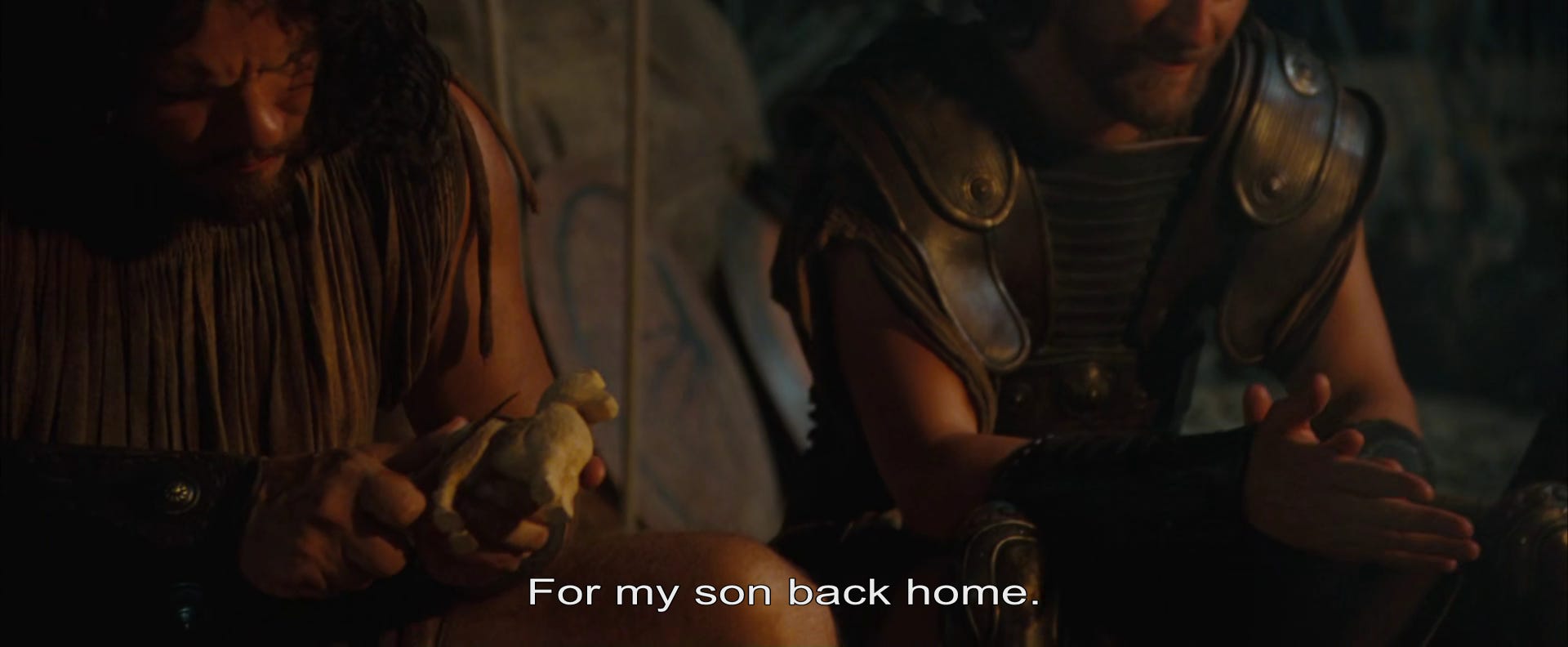
While its marketing was inescapable at the time, I don’t see many cinephiles these days talking about Wolfgang Petersen’s Troy, the 2004 adaptation of The Iliad which depicts the epic poem as a battle of hunks and hams, led by Brad Pitt and Brian Cox respectively. You can call it dynamism or inconsistency, but the real war being waged is not that of Greeks and Spartans, but pretty-boy swag and theatrical boisterousness. If there is a midpoint between the two camps it is Eric Bana’s Hector, who castigates a childish Orlando Bloom with great over-the-top vigor early on, before appearing to fit in with Pitt’s music video acting later on in scenes with Peter O’Toole.
After a tumultuous development period, the film landed in the hands of grand-scale journeyman Wolfgang Petersen (Das Boot, In the Line of Fire) and Game of Thrones screenwriter David Benioff, whose modifications to Homer’s Iliad were widely criticized. Defending himself on the DVD commentary, Benioff said that his strategy of adaptation was always to make the choice that benefitted the film, rather than faithfully respecting the source material. In theory, this is how great adaptations are forged, translating a text to cinematic language rather than simply using it as a screenplay. However, I’m not entirely sure Benioff knows what makes for a good movie, and his grand contribution to one of humanity’s longest-lasting stories is to make it all about cousin death. How many more cousins must die? The two Benioff credits that I do enjoy, 25th Hour and Gemini Man, are admittedly quite lacking on a script level, elevated to quality cinema through every other element that makes a film.
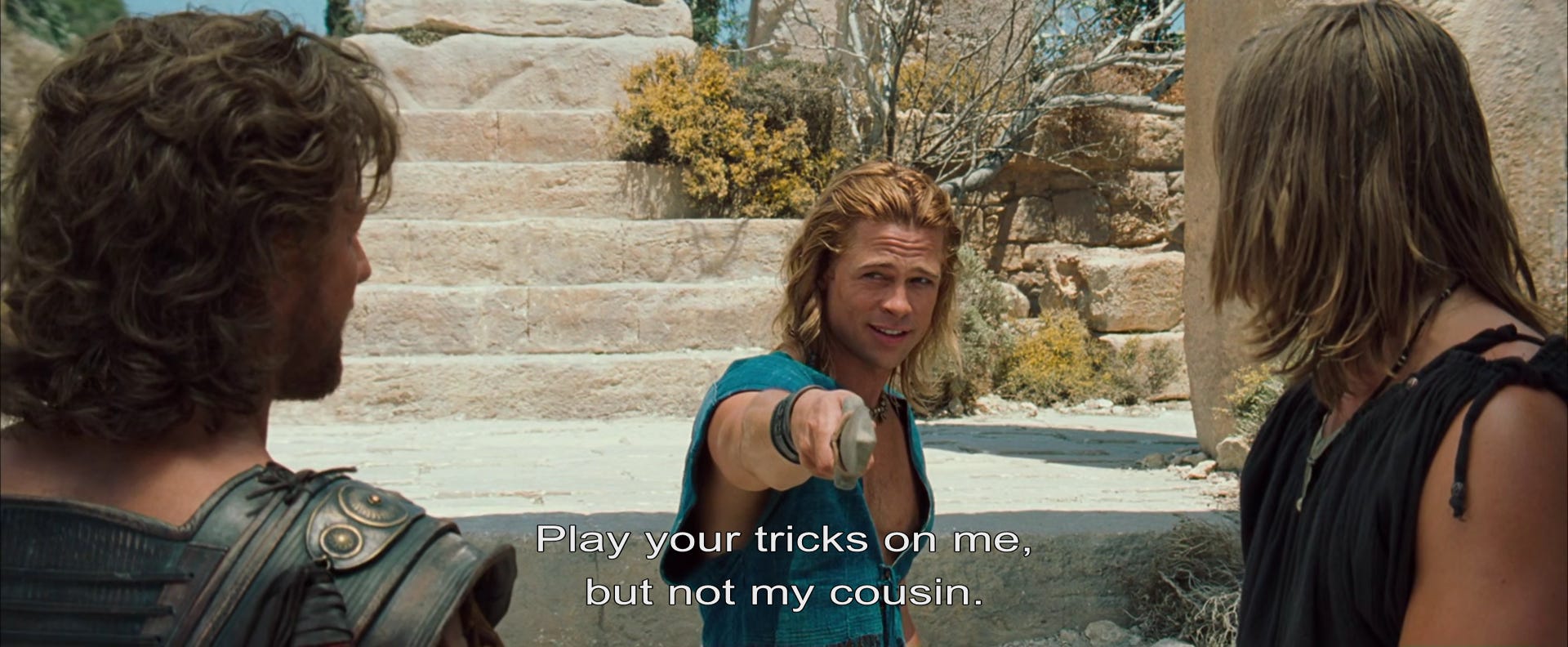
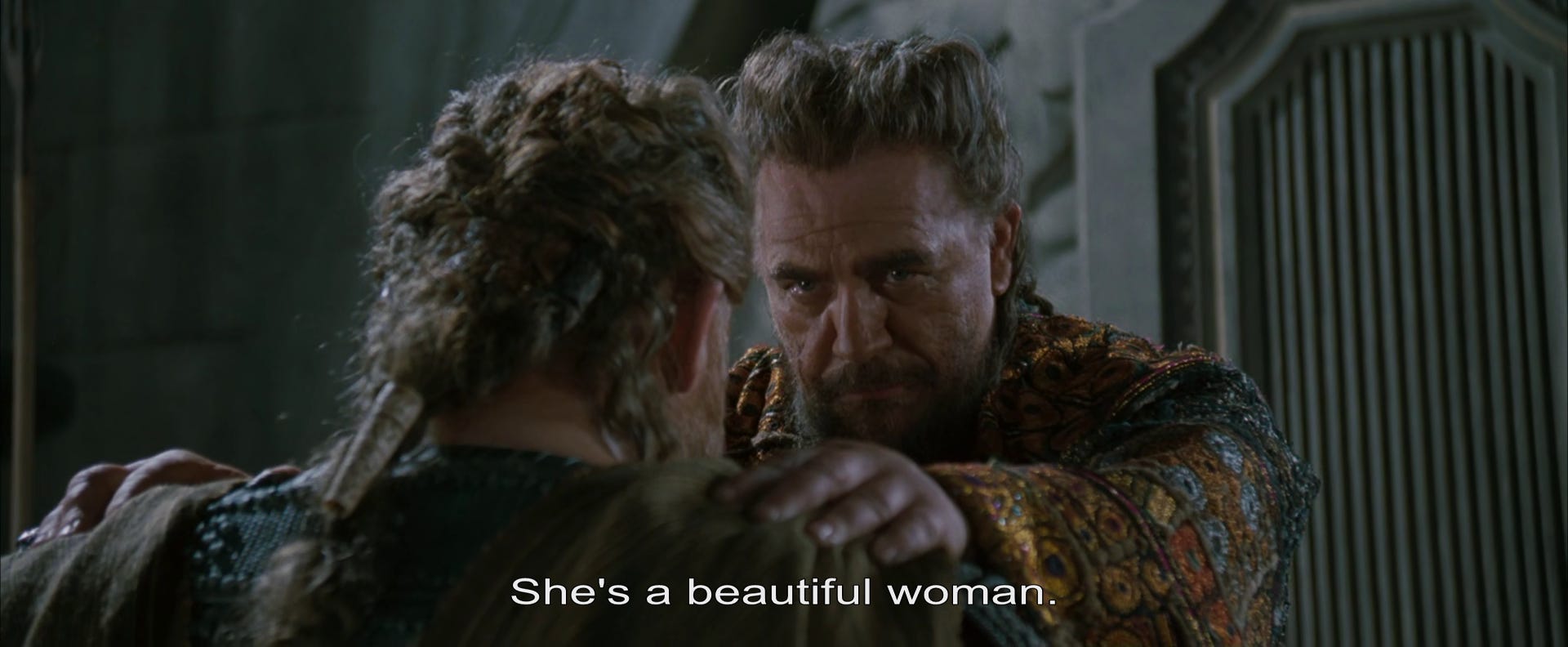
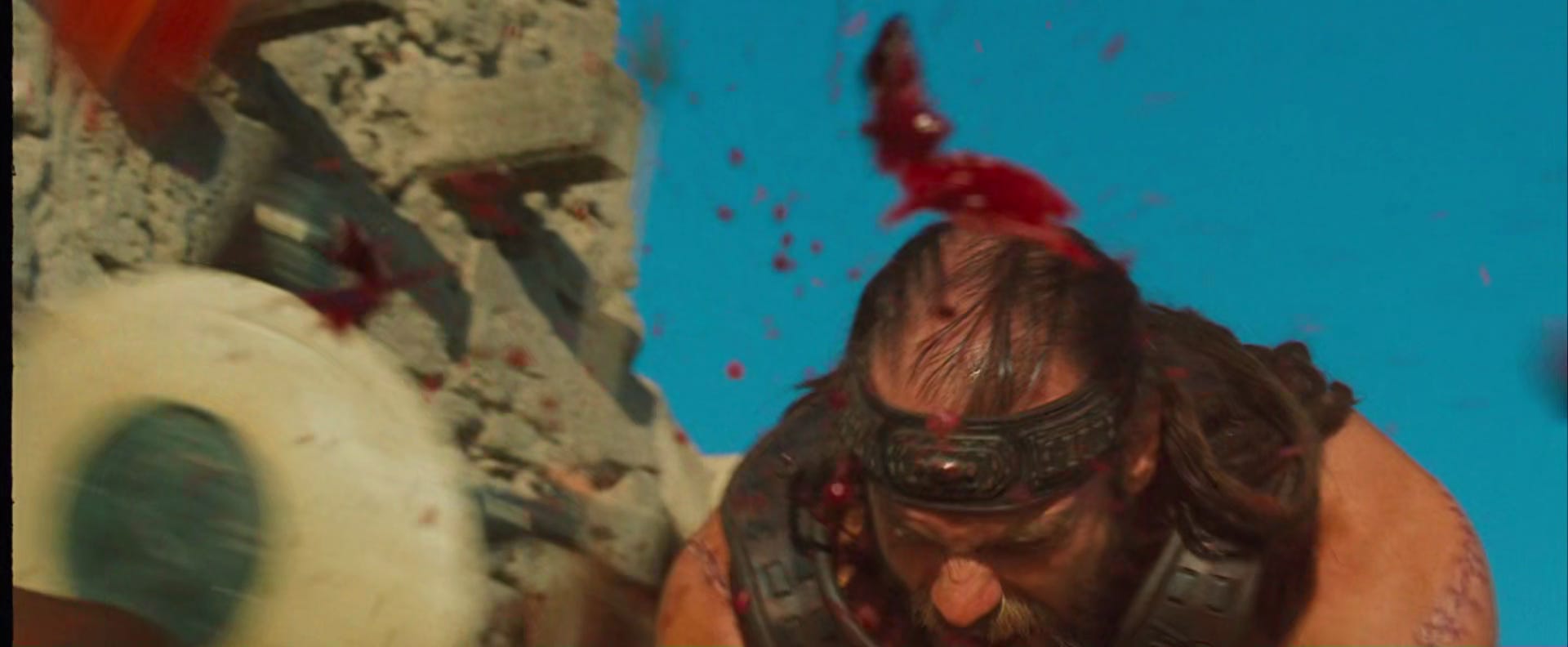
Troy does not quite reach those heights, but director Wolfgang Petersen does a very admirable job managing the setpieces. All too often, a war film depicting two sides charging at each other becomes one mass blob with nothing discernible, and the climactic battles are far less interesting than the scenes that come between them. Petersen, however, is able to manage the tightrope walk of micro and macro by shooting wides that don’t lose sight of the basics of landscape composition, and punching in on acts of ultraviolence that I found truly shocking. Over the course of the absurd 191-minute runtime (director’s cut), the amount of fake blood spilled and limbs dismembered is tantamount to the average Troma production. A note on length: Sometimes a movie feels 100 hours long, but it’s okay because you don’t have much else going on that day. A quick perusal of Wikipedia indicates a number of changes in this extended 2007 re-release that gesture toward a Mulvey-like idea of auteur cinema being nothing more than a phallic instrument:
The score of the film was changed dramatically, with many of the female vocals being cut. Various shots were recut and extended. For instance, the love scene between Helen and Paris was reframed to include more nudity of Diane Kruger. The love scene between Achilles and Briseis is also extended. Only one scene was removed: the scene where Helen tends to the wound of Paris is taken out. The battle scenes were also extended, depicting more violence and gore, including much more of Ajax’s bloody rampage on the Trojans during the initial attack by the Greek army and his duel with Hector. Perhaps most significant was the sack of Troy, barely present in the theatrical cut, but shown more fully here, depicting the Greek soldiers raping women and massacring the soldiers of Troy.
Returning to the dramatic pre-production process, I’d like to pose a theory: the final decision by Warner Brothers to have Wolfgang Petersen direct this film is one of, if not the most consequential studio mandates of the 21st century. While Troy itself was quite inconsequential, the carousel of this hiring process was not. Petersen had developed the film as a producer, and after Terry Gilliam turned down the directing job (which could have saved his career), it was offered to Christopher Nolan, fresh off Insomnia and Memento, who accepted the assignment, as Wolfgang was set to direct a doomed Batman vs. Superman film. Once this comic adaptation, later revitalized by Zack Snyder, fell apart in pre-production, Petersen made his way home after fighting—perhaps on the wrong side—the war of cinema versus comic books, and rejoined the film as its veteran director. The relatively young Nolan was ousted, then given the keys to Warner Brothers’ replacement for the dead superhero link-up, Batman Begins.
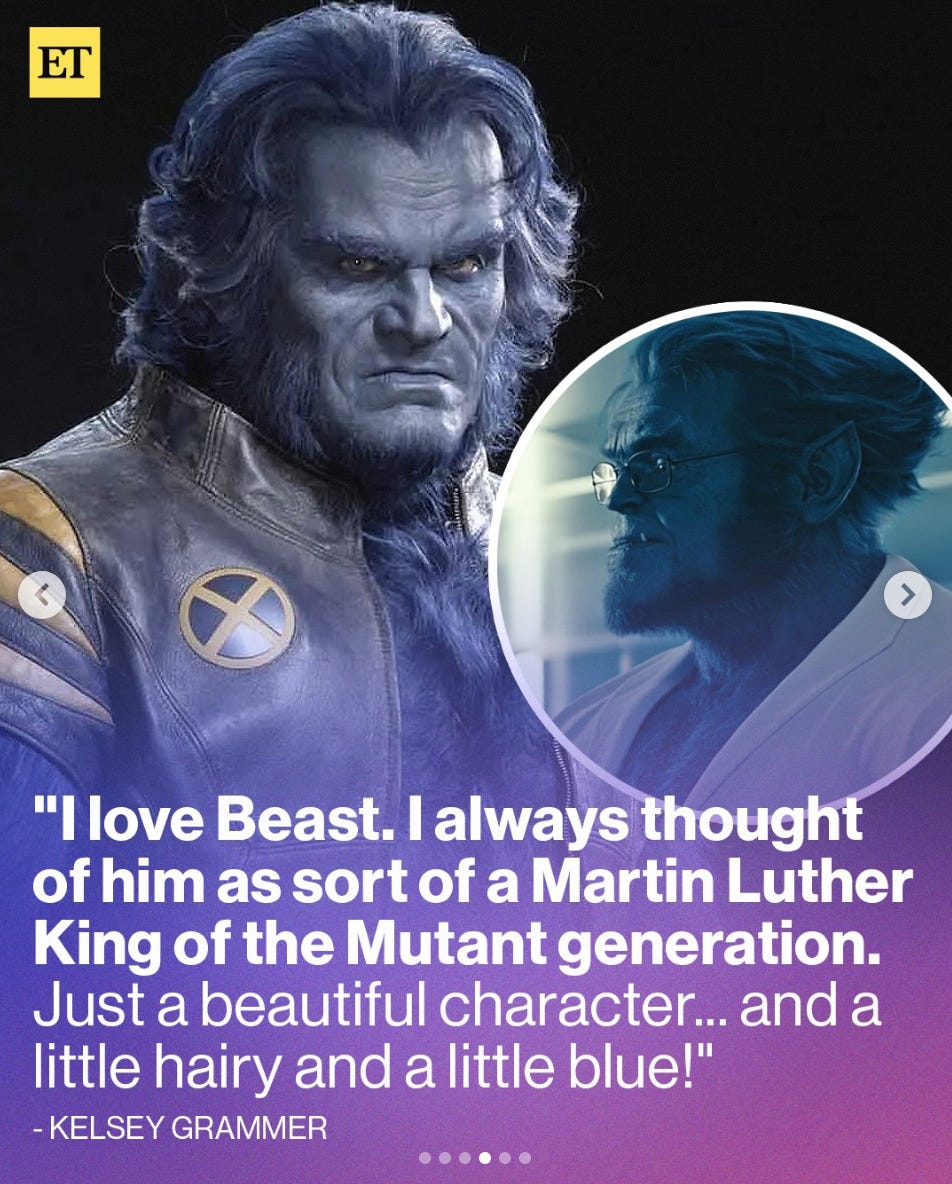
This is one of the great pivot points of the last few decades of cinema, as Christopher Nolan’s (admittedly fun) films about a caped billionaire who beats up guys like Ra’s al Ghul, The Joker, and Bane earned enough critical goodwill for the superhero comic book movie to be taken seriously by audiences, critics, and executives alike for the better part of two decades. But what if that didn’t happen? What if Wolfgang Petersen made Batman vs. Superman, and its impact was no more outsized than the Brett Ratner X-Men movie in which Frasier Crane plays The Beast?
While the success of Iron Man was directly responsible for Marvel and Disney’s chokehold on the box office and big-budget filmmaking trends at large, it’s hard to imagine Robert Redford lending himself to The Winter Soldier or Gwyneth Paltrow handing her career over to the Avengers universe without the respectability of Nolan’s Batman movies, with their beloved turns by Gary Oldman, Cillian Murphy, Eric Roberts (okay, I’m kidding about that one), Aaron Eckhart, and of course, posthumous Oscar-winner Heath Ledger. Would Disney have remade Star Wars in the image of Marvel if their superhero films (which initially rode the wave of Nolan’s) weren’t so absurdly profitable? Would “superhero fatigue” be a concept that critics talked about with genuine seriousness circa 2018 if Christopher Nolan had directed Troy? I think not. Of course, it all comes full circle with the upcoming Odyssey as Nolan takes on a meta-role not unlike Odysseus, having fought the war and returned home to the Greek epic poem, and perhaps there is an added directorial vigor to be expected in this personal make-good project, with the foppish auteur having taken his talents across the southeast valley from Warner Brothers to Universal in recent years.
Homer’s Odyssey
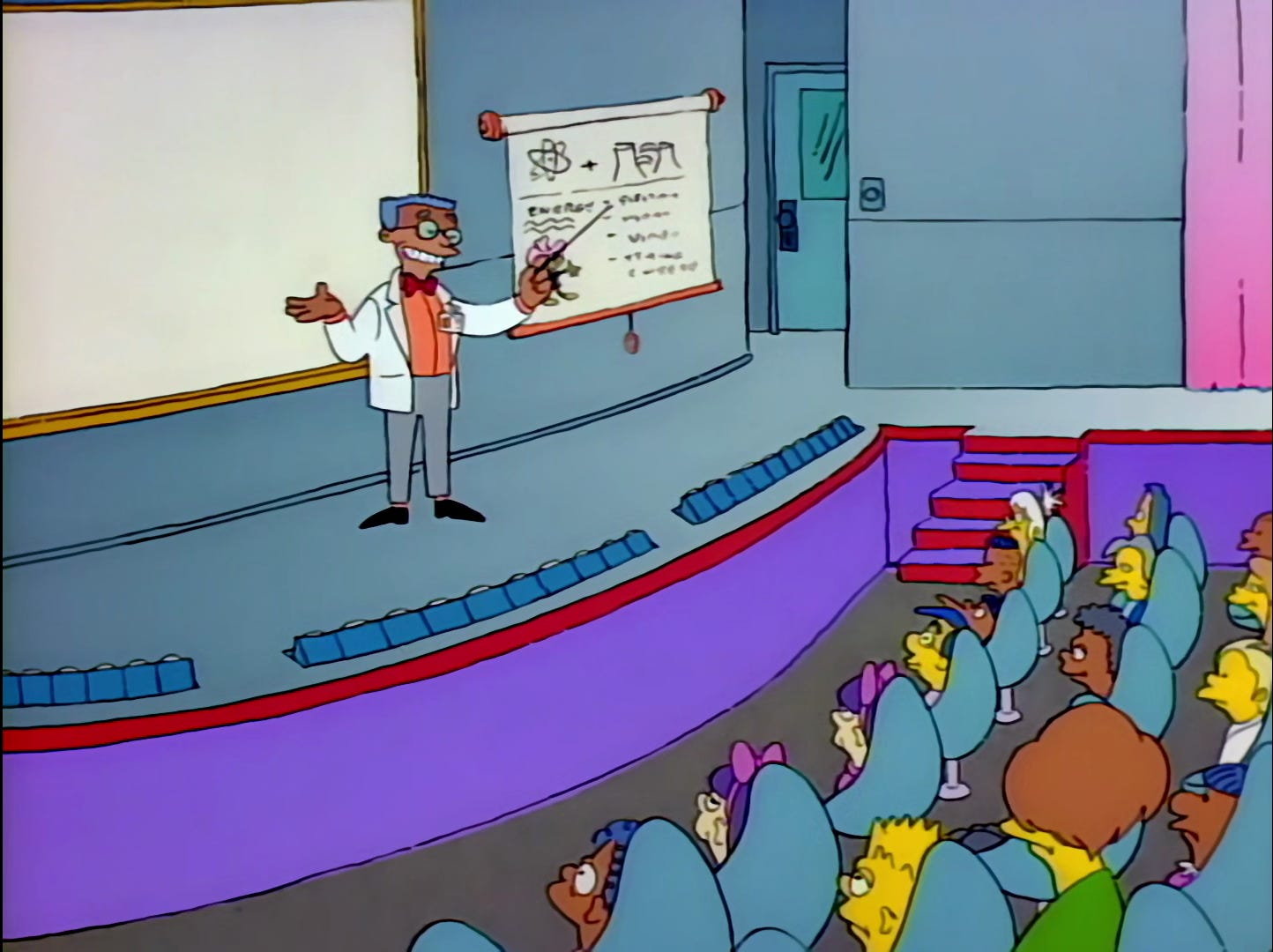
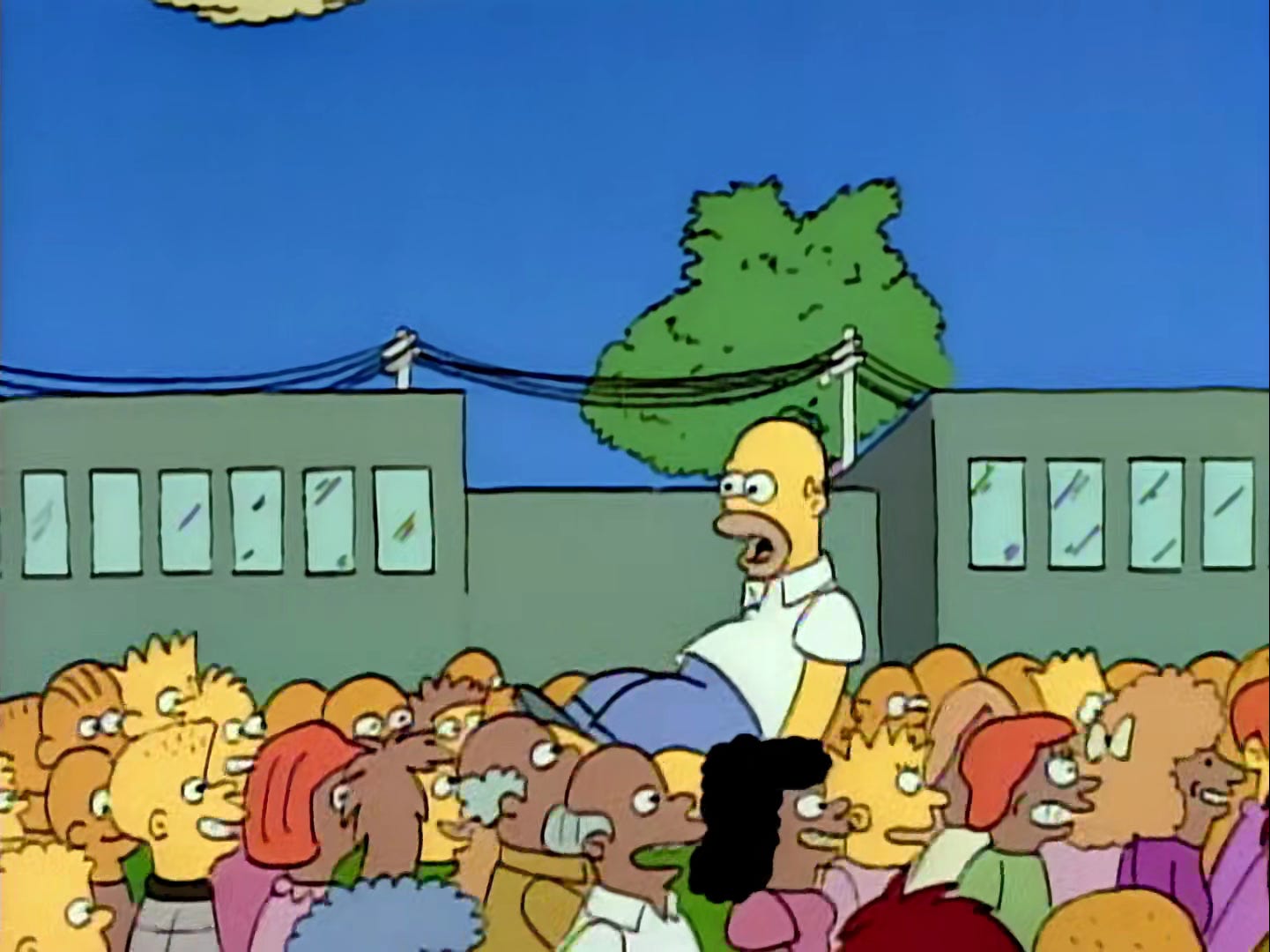
The Simpsons, my favorite television show of all time, has two adaptations of The Odyssey (one, really). The very first-produced episode, aired as the third, was called “Homer’s Odyssey.” Despite the fact that America’s yellow patriarch was named after a character in Nathanael West’s The Day of the Locust, one has to figure that nodding toward the epic poem was simply something that the writers had to get out of the way. The episode has little-to-no discernible connection to The Odyssey, but I revisited it for the sake of completism. As I’m sure is the case for any Simpsons-head upon returning to the first season, I was quite taken aback by everything that would change radically within a year or two. The animation seems a bit off, with most characters missing a tooth or two. Homer sounds like Walter Matthau, Smithers is Black, Mrs. Krabapple continually calls Bart Simpson by his full name, first and last, and the jokes aren’t particularly great. Where the early episodes like this do excel is in the realm of sentimental family drama. While the jokes themselves aren’t nearly as off the wall as they would become, the plot itself is quite absurd in this early outing, as Homer is fired from the nuclear power plant and tries to kill himself before becoming a crusader for public safety. Eventually, Mr. Burns rehires him in the capacity of safety inspector, and despite selling out his protesting comrades, Homer is hoisted by the crowd like a king of kings for making the plant safer. While hindsight is 20/20, if this particular episode existed in a vacuum, its finale would be quite deflating and disappointing. However, knowing what would become of Homer’s career, regularly being called into his dictatorial boss’s office with a sinister “Simpson, eh?”, one can place it in line with the absurdist irony that ends so many classic episodes.
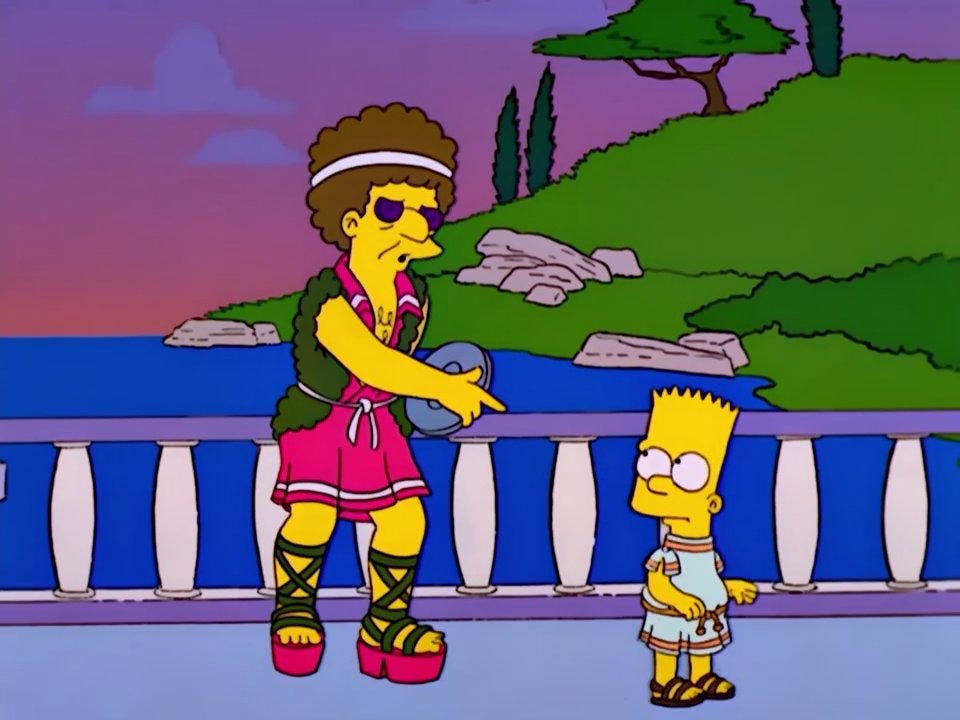
Bypassing the peak of the show (seasons three through eight) entirely, I skipped ahead to “Tales from the Public Domain,” the 14th episode of the thirteenth season. It originally aired on March 17, 2002, and I was seated on my mom’s couch in front of the television on that Sunday evening. In fact, this may have been a number of personal firsts: My first new Simpsons episode that I intentionally tuned in for, and my first exposure to all three timeless stories that are abridged and re-skinned to center around Springfield’s panoply of characters. Through a framing device which (perhaps unbeknownst to the writers) borrows a plot from Seinfeld, that of the decades-overdue library book, the anthology retells The Odyssey, Hamlet, and the story of Joan of Arc. It’s a shame, how deceptive memory can be. I had often thought back to this episode when The Odyssey came up in conversation, and have told multiple people that Ralph Wiggum was the cyclops. This is, unfortunately, not true at all. After a bit of research, I found a deleted scene in which Comic Book Guy appears as the one-eyed beast. Ralph’s father, the Edward G. Robinson soundalike whose “bake ‘em away, toys,” is perhaps my most oft-quoted line from the series, appears as a cyclops in the 24th “Treehouse of Horror,” which was notably co-directed by Guillermo del Toro. A mental conflation would have been possible if there was any way I’d seen these images before, but I’ve never watched any deleted scenes past the eighth season, or any full episodes past the fifteenth or sixteenth season. This is all to say that I would have preferred this six-minute truncation of The Odyssey if it featured Ralph Wiggum as a cyclops, but his turn as Laertes in Hamlet is quite good. The episode is incredibly lopsided; The Odyssey (or “D’oh Brother, Where Art Thou?”) is so good that I wanted more (an incredibly rare feat in post-peak Simpsons), Lisa’s Joan of Arc (“Hot Child in the City”) is a bore, save for Milhouse’s cool haircut, and Hamlet (“Do the Bard, Man”) has a few decent jokes. While there isn’t much to analyze as far as these parodies go, nor is there anything to indicate what this weekend’s much-anticipated blockbuster will entail, I think it’s safe to say that Christopher Nolan will not provide me with anything as funny as Disco Stu making a pass at Bart. I also think that I like this show too much because I started imagining a feature film version of the first segment of this late-period episode with glee, despite the fact that everybody else in the world would surely hate that idea.
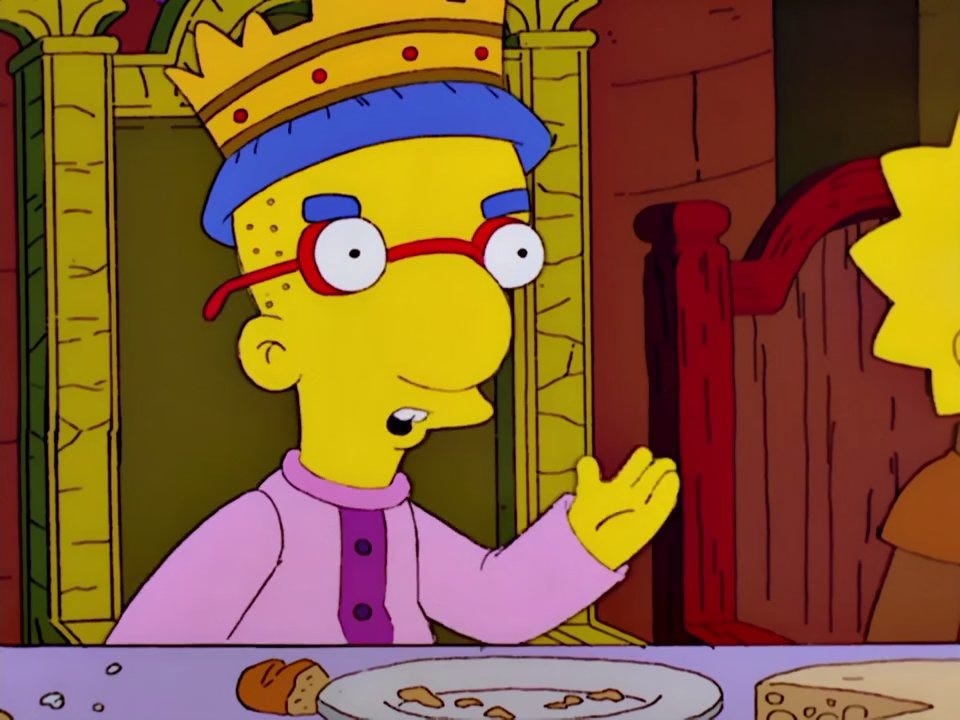
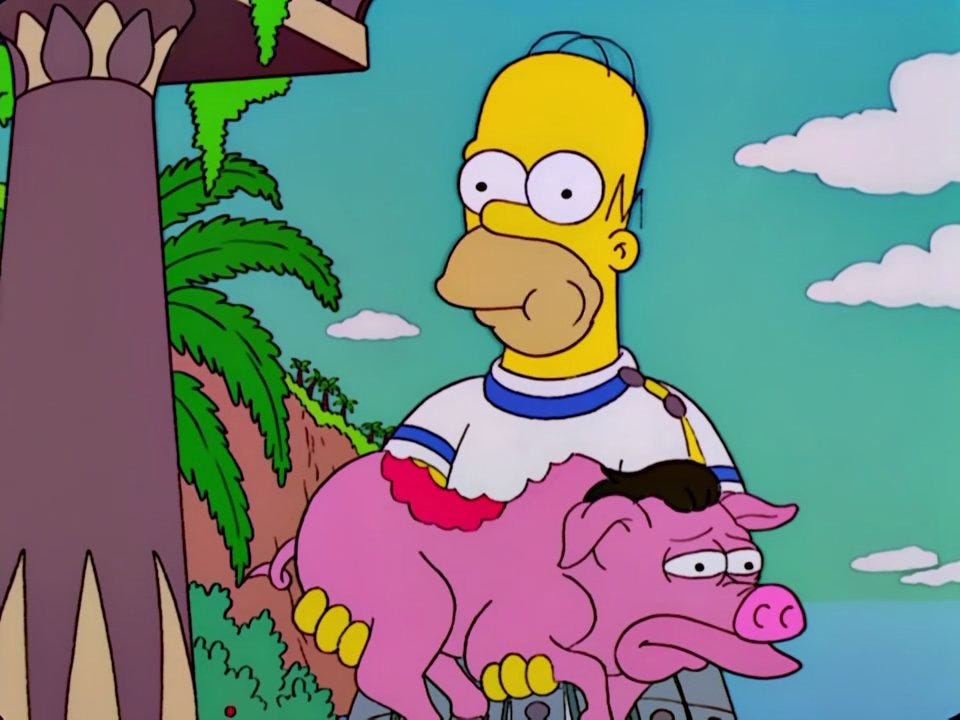
Sidenote: In my constant cycling through Simpsons discs, I have once again reached the end of the peak, as I am in the midst of season eight. Would any of you be interested in what I have to say about the decline of the show? I remember the ninth season having a few really great episodes, and am curious as to what would happen if I indulged in it for the first time in at least 15 years. “The Principal and the Pauper,” episode two of the ninth season, was often seen as the shark-jumping moment of the series, but it can’t possibly be worse than the few clips I’ve seen of the show from the last few years, can it?
Insomnia
Keeping in the auteurist tradition of this blog, I figured that the only way to truly prepare for a Christopher Nolan movie is to watch Christopher Nolan movies. My only blindspot in his filmography, until very recently, was Insomnia, a remake of the 1998 Swedish film by Erik Skjoldbjærg. Following the success and unique vision of Nolan’s sophomore feature Memento, Steven Soderbergh and George Clooney nudged Warner Brothers to hire the suit-wearing director to helm the project through their Section Eight production company, bringing him into the WB fold for a very successful decade.
Christopher Nolan is a director whose work I’ve gone back-and-forth on over the years, before settling into a fairly mild opinion around the time of Tenet. His film style and persona can be defined by behind-the-scenes footage of him in a suit, or at least a suit jacket and a button-down, giving direction to a man in a Batman costume. His demeanor is that of self-seriousness, but the work itself is often quite silly. The reason why films like Inception or The Dark Knight were lauded as “genius” comes down to the cohesive and seemingly grown-up formal approach, whereas other heady filmmakers of his time (say, Paul Thomas Anderson, Tarantino, or the Coens) indulged more in the pyrotechnics of screenwriting. As a teenager, I was squarely in the camp that called him a genius, but in my college years and beyond, the recurring shortcomings of his scripts lead me to consider him quite overrated, even hackneyed. Also, as my taste in the aesthetics of film grew more refined, the very busy and sometimes shaky widescreen compositions of cinematographer Wally Pfister became less and less interesting.
However, around the time of the COVID lockdown, I watched/rewatched his collaborations with Hoyte van Hoytema (Interstellar, Dunkirk, and, on the very same day I received my first dose of the vaccination, Tenet), and found myself quite enamored. With his new DP and an IMAX fetishism that had been brewing since the opening heist of The Dark Knight, the frames were much cleaner, and the use of space seemed to be much more architecturally driven, which was teased in Inception. While I still held most of his work at an emotional and dramatic remove, these films had once again become incredibly fun objects, and what I previously perceived as weaknesses eventually folded into light pleasures. Looking back at my Letterboxd notes on Interstellar from a few years back, I wrote that “if the form and logic always shined while the pathos was laughable in most of Nolan’s previous films, he finally figured out the formula here.” Nolan had to bury himself in scientific theory in order to craft a successful melodrama, which sounds counterintuitive, but this contradiction informed what I had grown to love about his work, and I still find Interstellar to be his greatest film specifically due to the way he struck this balance. Continuing this thread, I was a bit harsher on Batman Begins, writing that “I’m always glad when something this simultaneously dumb and well-crafted exists.” Inception is another favorite in his catalog, because no matter how many YouTube videos of bozos explaining its supposedly mind-blowing finale may exist, it is still a film with the tagline “your mind is the scene of the crime,” and is no more than a pulpy sci-fi film made with impeccable form and very impressive intercutting in its third act. I’m not above Christopher Nolan, because I love the pleasures of genre films, and so does he.
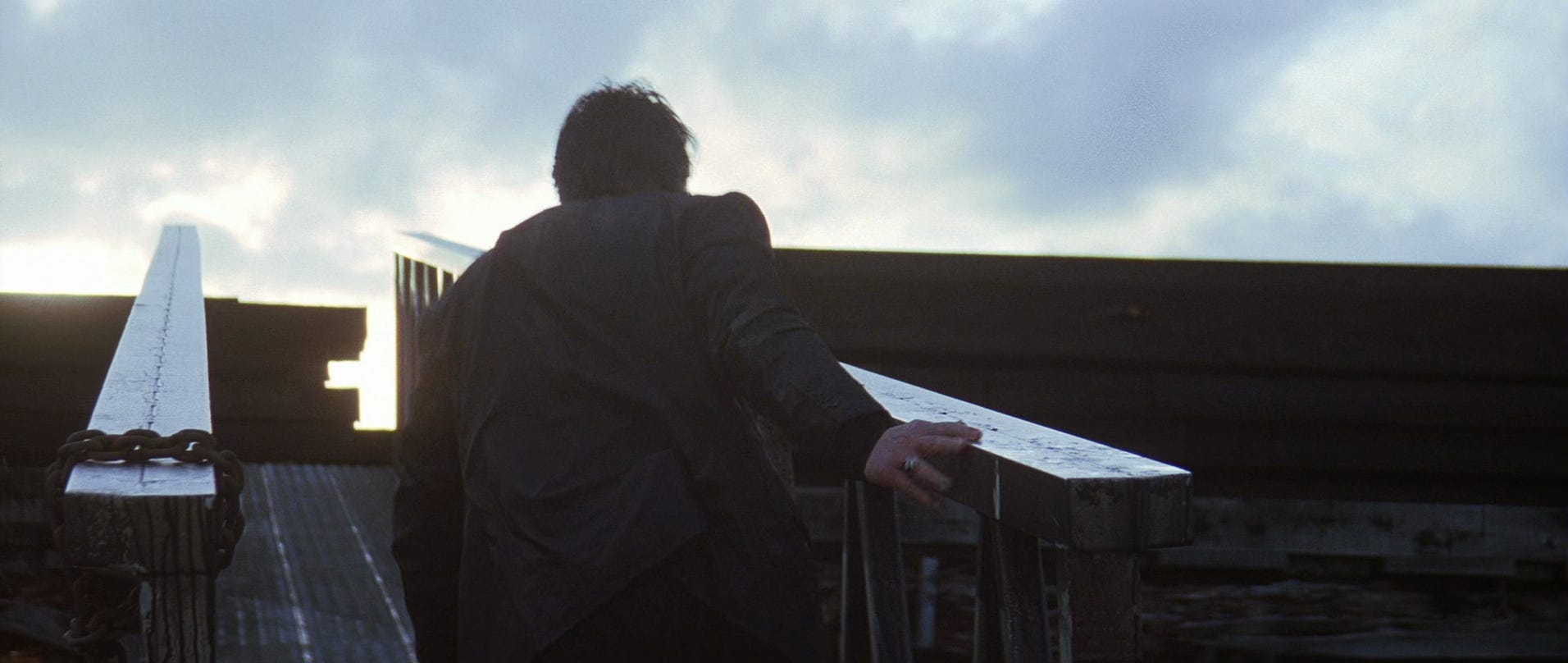
And so, with the achronological preamble out of the way, let us return to Insomnia. Not only is it a remake, the adapted script is the only one Nolan ever directed that he himself did not write, which leads to a quasi-anonymous feeling. This excited me, because the imposition of one’s artistry upon someone else’s product is how the original auteurs of the studio era did it. It’s an assignment film, and the Nolan-isms aren’t exactly kept at bay, but they are subdued compared to his later work. Part of this can be credited to (or blamed on) the performance style, mainly that of its leading man. Al Pacino, fresh off his last attempt at subtlety (The Insider) and one of his loudest films (Any Given Sunday), plays a crooked Los Angeles homicide detective who, for some reason, is called to the Alaskan town of Nightmute, where the sun never sets during summer, to solve a murder alongside his partner Martin Donovan, who is slightly more animated than his usual presence. The first hour follows a surprising amount of the same beats as Twin Peaks, with its investigation into a small town high school girl’s murder, led by an outsider whose way of doing business isn’t quite what the locals are accustomed to. Hilary Swank plays a young officer whose innocence will be lost, which is clear as day from the first moment she eagerly takes advice from a drowsy Pacino.
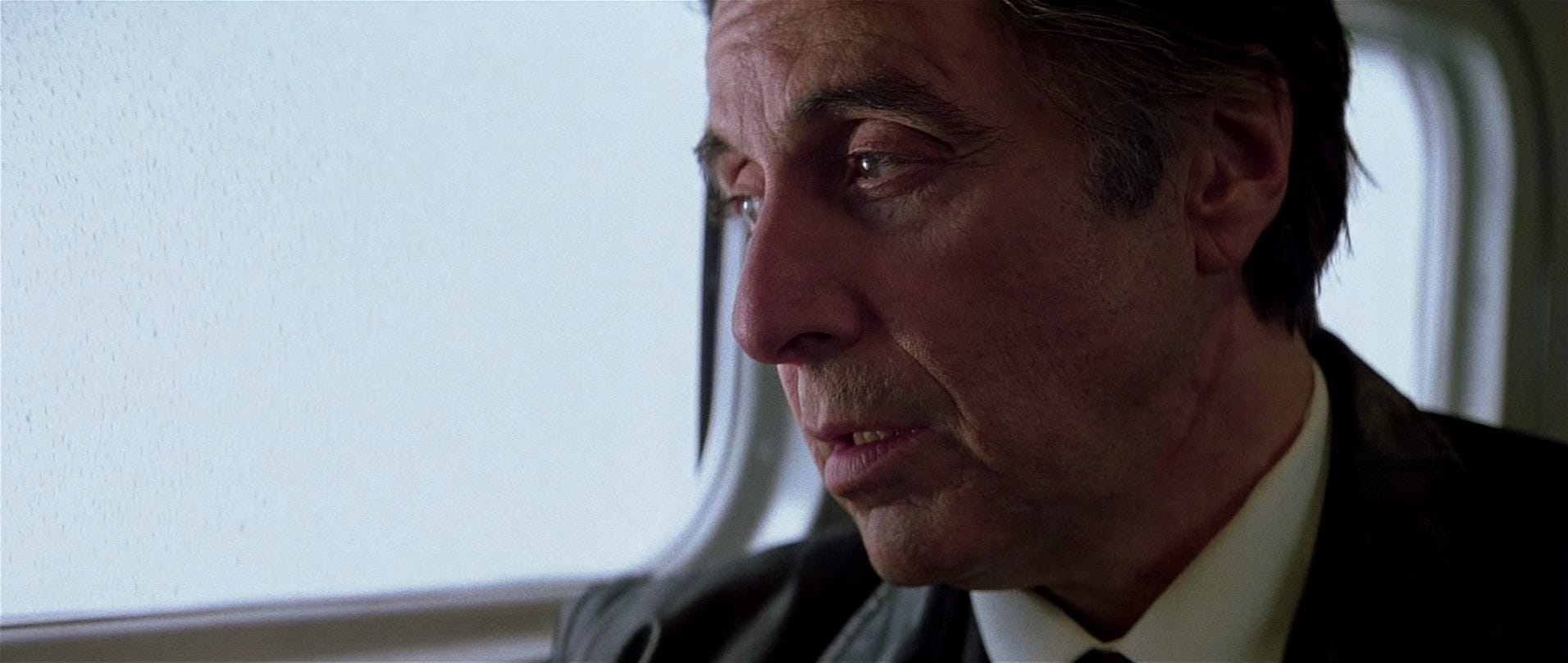
The success or failure of the film seems to depend on whether or not one can take seriously the reveal of the killer’s identity: Robin Williams as a mystery writer. Unfortunately, Good Will Hunting is still the only non-comedic role that I’ve enjoyed from the star of Robert Altman’s Popeye, but I’ll still hold out hope for his much-lauded episode of Homicide.
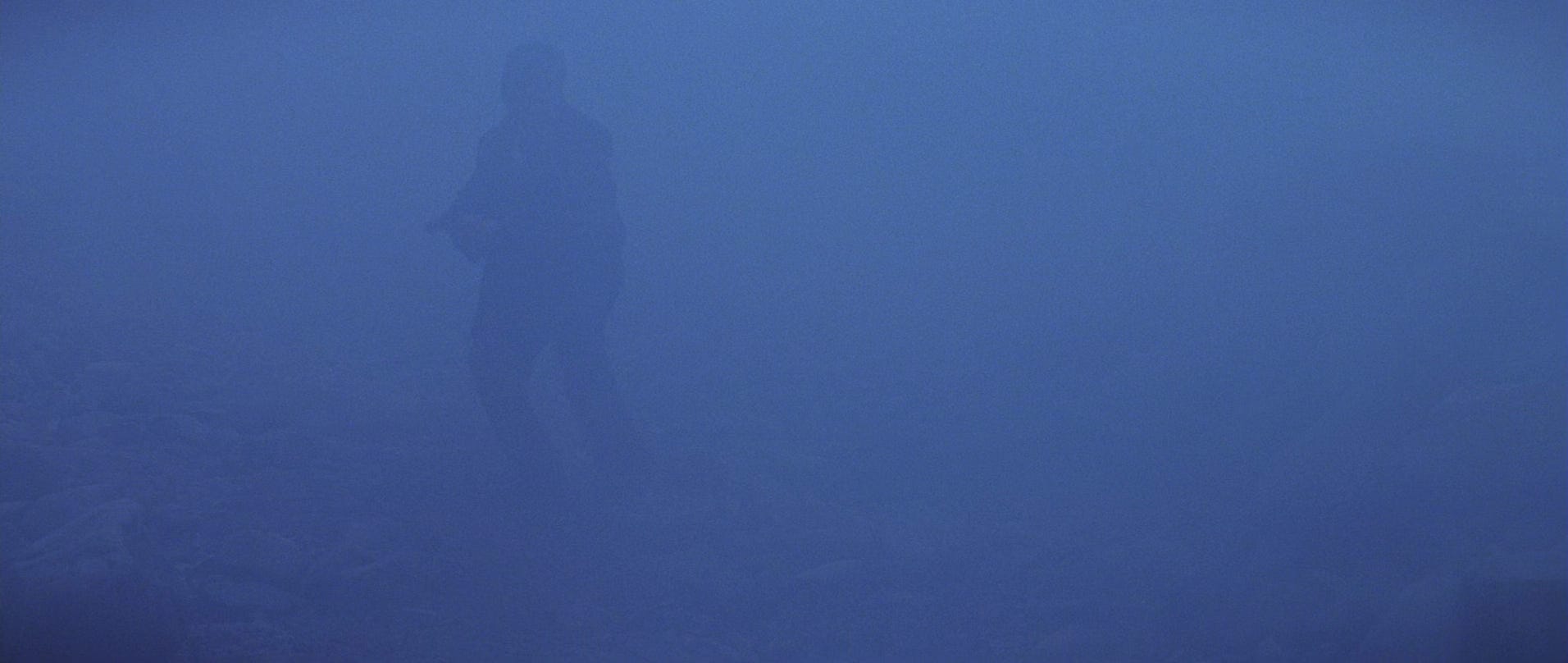
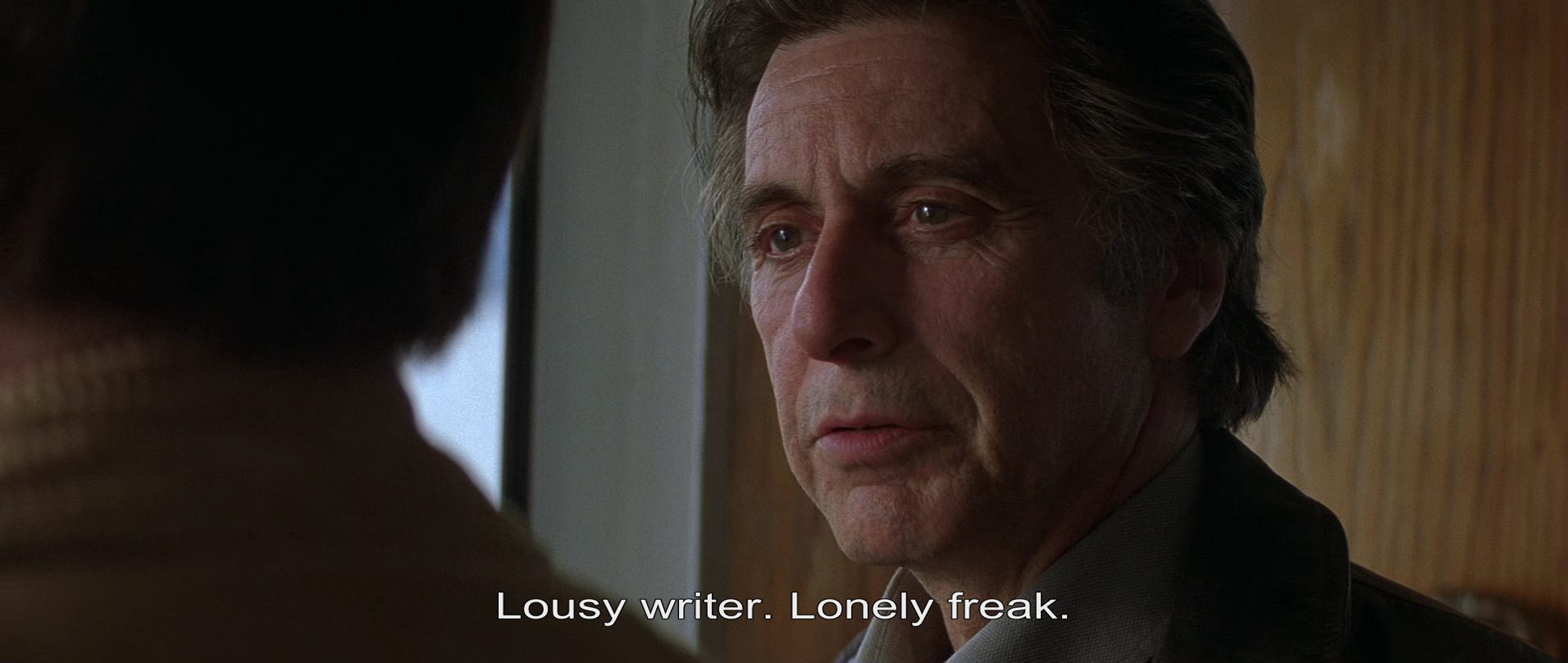
The beats of the story are incredibly predictable, with no real surprises to be had in the genre process or the personal arcs, but the execution is quite impressive for the most part. When Pacino murders his partner at the first act break, the deep blue misty haze that obscures the action and forces the actors into silhouette is breathtaking. In fact, Nolan and Pfister indulge in the natural beauty of their setting here more than they ever would in subsequent collaborations. The sleep-deprived hallucinations that increase with frequency as the film barrels toward its conclusion are effective, with the reverse shots of Pacino selling the emotions quite well. Like most of the filmography I’ve been describing, there is no shortage of moments that I found silly, or in less generous terms, stupid. The editing and use of body doubles in a foot-chase between Pacino and Williams feel like the shortcomings of a late period Steven Seagal or Charles Bronson movie, as the 60 and 50 year-old actors defy time and space itself without breaking a sweat. Moving into “spoiler” territory (for a 24 year-old film, mind you), the finale indulges in Nolan’s penchant for symmetry and a solving of the puzzle box as the antihero and villain shoot each other in the chest simultaneously. “Just let me sleep,” a dying Pacino tells Swank, and while my eyes couldn’t help but roll, I thought back to how annoyed I was at the twin reveal that ends The Prestige, and am glad to say that I’m a little more forgiving of these tendencies as I grow older. While it’s far from his best work, Insomnia is a solid crime film that almost avoids the trap of taking itself too seriously, and I’m afraid that, due to his outsized reputation in tandem with the pomp of Oppenheimer and The Odyssey, we may never again see this side of Christopher Nolan.
I would be interested in a piece about the decline of The Simpsons, in large part because I have never seen a single episode of the show before and am looking to dive in soon. Seems like the consensus is Season 8 is still good, but no one agrees on how long to keep watching after that.
That was a good ramble I enjoyed this one! I think Insomnia was the first film I can recall anticipating solely because of a director's previous film had impressed me (Memento) and seeing it on the Big Screen and not renting it on DVD was incredibly exciting.
I liked it then but didn't love it and I think I never really warmed to Nolan again TBH. Will be attempting to see The Odyssey with an open mind!