Her Private Hell
The Little Match Girl’s Descent

Vintage Violence is a blog about film, literature, and more. For the rest of August, paid subscriptions will be on sale for $4/month or $24/year. If you enjoy free posts like this one, consider getting the deal and making the upgrade!
In 2005, Dario Argento tested the patience of his longtime supporters with Do You Like Hitchcock? While Nicolas Winding Refn has never sustained a period of acclaim and influence quite like Argento’s peak, his last decade of streaming content and advertising has led him here to ask, through style, Do You Like Argento? But when the digital giallo stylistic approach is combined with the text of the film, he asks, Do You Like NWR?

He’s a filmmaker equally indebted to the arthouse and the grindhouse, to Jean-Pierre Melville and William Lustig, bringing about a new definition of middlebrow which tends to aggravate filmgoers whose preferences operate on a false binary of art and sleaze. Over the course of my time writing about film, I’ve seen his work categorized as stupid by those who consider themselves his intellectual superior (which they may be) and pretentious by those who consider themselves a deeper appreciator of genre depravity (and they may be). Through his laconic scripts, provocative subject matter, penchant for violence, and highly stylized, often surreal imagery, he can easily be called just about any derisive adjective in the book by one critic, while another critic may simply retort, “isn’t that the point?” In Her Private Hell, the tasteless violence, and particularly the artifice and vapidity are very clearly self-conscious and critical, coming from a filmmaker who has taken assignments from Prada and Hennessy in recent years.
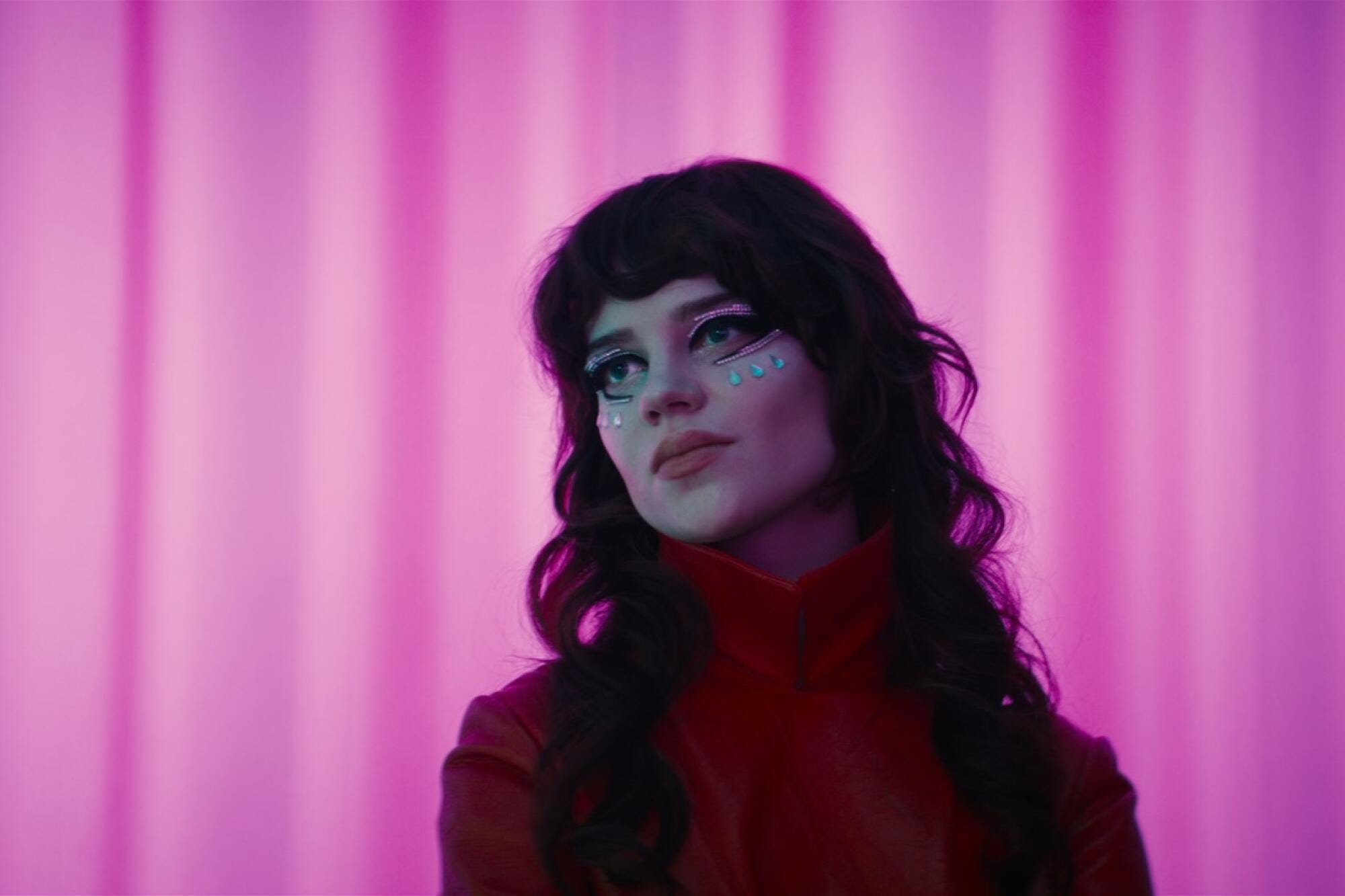
The film follows Elle, played by Sophie Thatcher, living in the generically named Hotel Tower while acting in a terrible-looking sci-fi film. She’s joined by a co-star and a wicked stepmother, who is implied to be the latest conquest of her father, Johnny Thunders, a man seemingly addicted to age-gap relationships in an effort to better understand his daughter. She and fellow actress Hunter (Kristine Froseth) witness a murder early on, as giallo protagonists are wont to do. The murder is committed by the Leather Man, a tongue-in-cheek name stemming from the typical outfit of a killer in the lurid Italian films that Refn is riffing on. His signature move is to dismember women by their breasts. This Leather Man is the link between the A and B stories, the latter of which is about Private K (Charles Melton). Kay/K (the credit reads “K” while his nametag spells out the letter) is a GI stationed in some nightmare version of Japan, wandering solemnly looking to avenge his daughter. While it seems to be the ambiguous and disguised killer who took his offspring, his retribution is against the Yakuza, setting up a surreal dynamic of real (or at least movie-real) criminality and otherworldly demons.
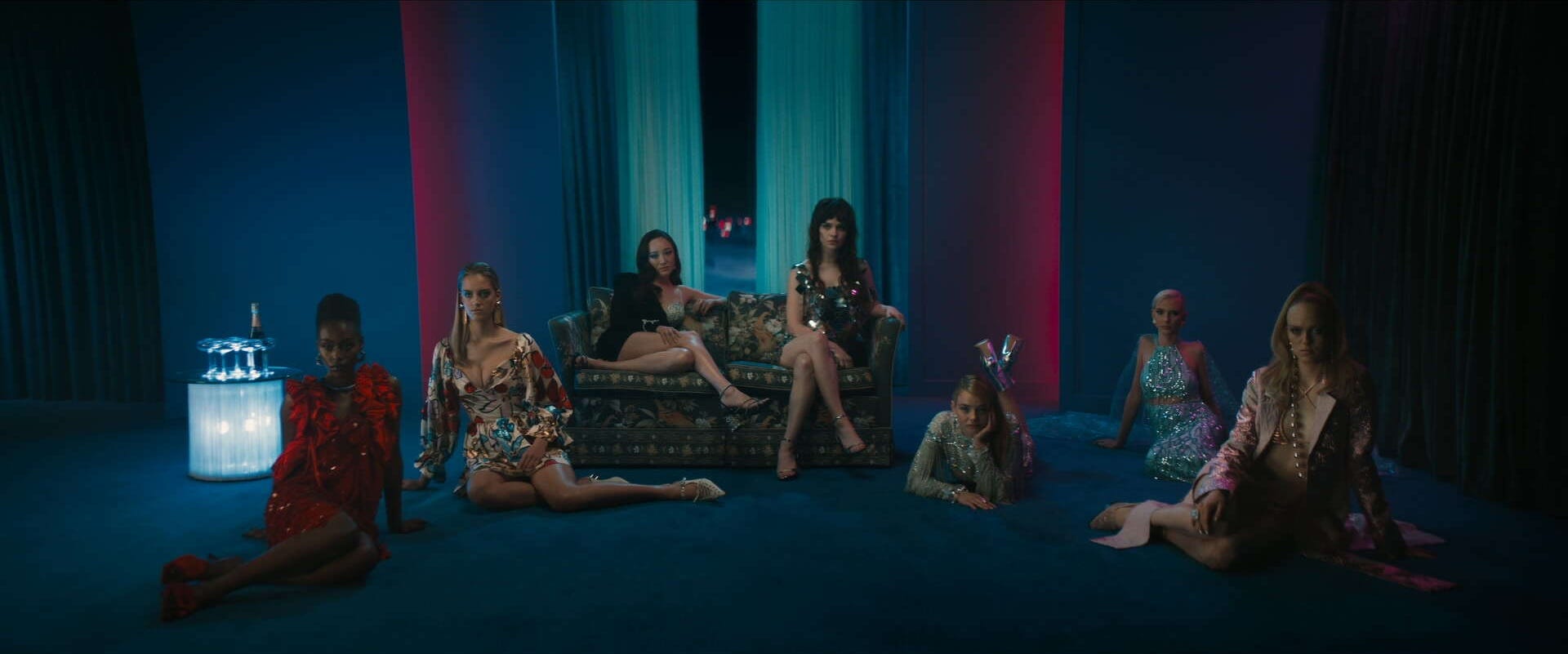
Artificiality is the film’s greatest strength, as its CGI skylines of an anonymous futuristic city set the scene for the drama, and Pino Donaggio’s lush, romantic score works to ease the viewer into Refn’s vision. Everything is shrouded in a hazy mist, the very mythical mist that brings out its supernatural killer. There is also another dimension in the film—one of purple, pink, and blue light fixtures shaped vaguely like icicles—which resembles the setting of an NWR fashion show, but then again, the entire film is a runway for his models/actors and his own visual style. This becomes more interesting when the setting is used across multiple realities; it is a dreamlike cutaway to describe a character, a set of the film within the film, and the location of its final confrontation between slasher and heroine. While this and the gaudy hotel suite are the recurring settings of the film, the dreamlike mise-en-scene reaches its peak at Uniform Night, an event at an underpopulated club whose lighting feels like a slow-motion strobe, where the film’s great set piece takes place.
Immediately upon entering the club, the psychosexual aspect of the film ramps up exponentially as the gelled lighting both shrouds and reveals tensions across the three women, the father (now absent from the film), and Nico (Diego Calva) who is simply irresistible to the cast. This is where Charles Melton’s plotline converges with theirs, where A meets B. After a brutal fight at a photography studio in which he wields brass knuckles and a switchblade with equal efficiency, and being humiliated by Japanese cops, K appears at the club—or does he? It seems as if he is encased in glass, forced to watch women who he knows will inevitably follow the fate of his lost daughter. After multiple mentions of Hans Christian Andersen’s The Little Match Girl, Refn reaches back to the fable’s great film adaptation by Jean Renoir for inspiration. While the story, from 1845, consists of a poor, freezing girl seeing all that comforts her within the flames of the matches she sells before a cold death, the 1928 version by Renoir depicts the girl transporting to a world of miniatures, encased in the glass windows of the toy store she stands before. In Refn’s film, Elle, after failing to seduce her stepmother, follows Nico into the bathroom. They have sex in front of a window, into which Hunter peeps, all the while the erratic lighting and editing slowly reveal their miniature scope in the grand scheme of the club, seemingly only recognized by Private K, made impotent by this impossibility. What follows would spoil the fun of the sequence more than I already have, but the climax to this oneiric, lusty set piece is worthy of former Donaggio collaborator Brian De Palma.
What follows is the most (relatively) grounded and chunk of the film, a melodramatic verbal spat which involves a lot of combative yelling, rather than the film’s usual glacially paced, deadpan, sparse dialogue. When this family dispute reaches its conclusion and the film returns to that icy world colored in shades of purple, it plays like a typical narrative denouement on the surface through a combination of powerful images and cheekily manipulative music, but of course, the preceding 90 minutes were anything but typical. While trying to make sense of every thread in the film would amount to grasping at elusive neon straws, much like the giallo films from which Refn adapts his playbook, there is a lack of handholding and obviousness that should come as a great relief to anybody who has suffered at the multiplex this year. Why bother seeking narrative cohesion when you have a contemporary approximation of Dario Argento’s lighting and Lucio Fulci’s fetish for violence inflicted upon eyeballs?