Send Help
Sam Raimi's exhausting thriller

The inaugural Vintage Violence Quarterly is currently open for submissions! The issue is on Infinite Jest, with a focus on how the novel connects to cinema. Send your essays and hybrid work, preferably in the 800-1600 word range, to vintageviolencesubmissions@gmail.com by February 14.
Vintage Violence is a reader-supported blog about film, literature, and more. Most of the posts are free, but you can subscribe at a paid tier to access the entire catalog and show your support.

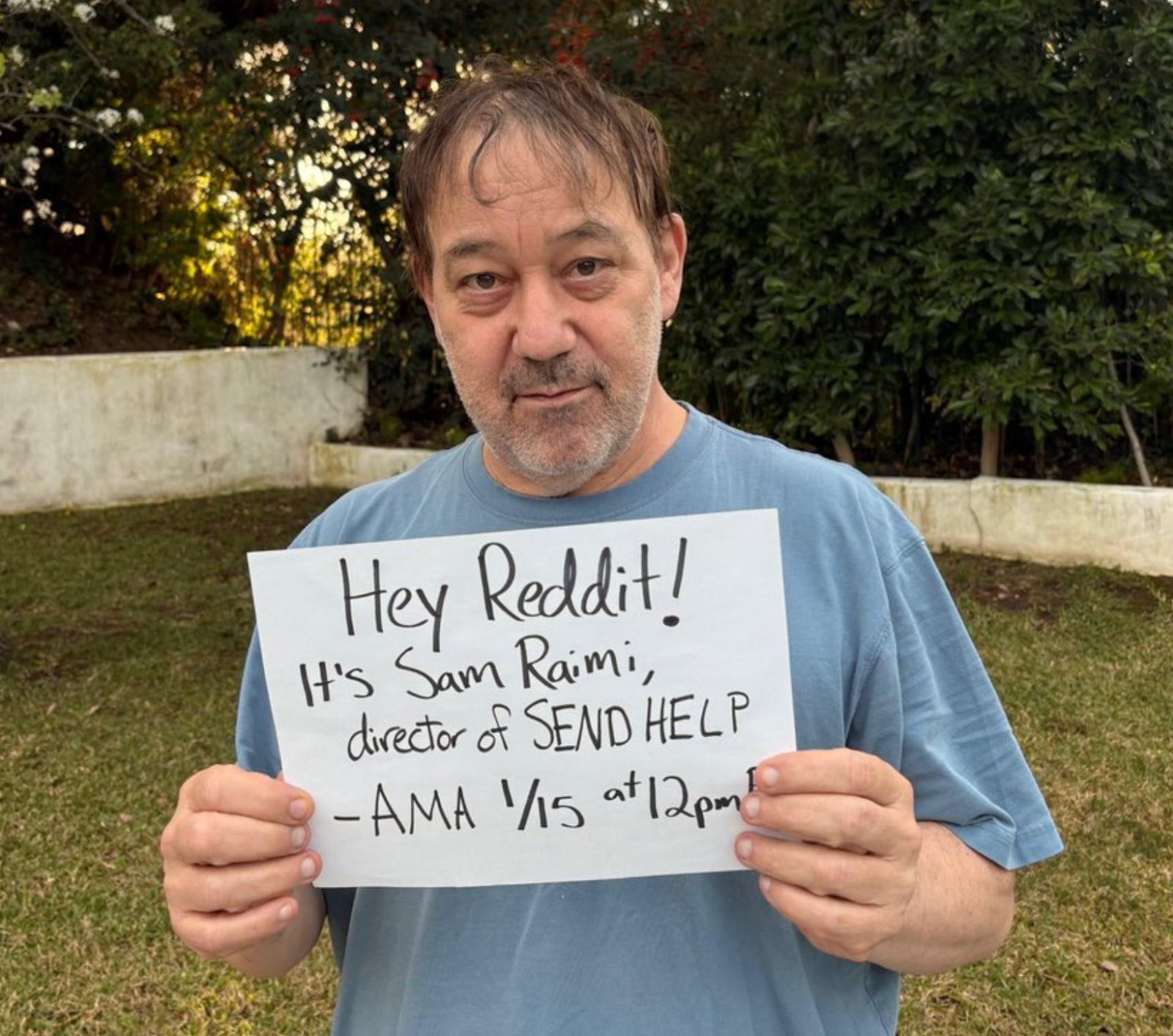
Send Help, the return to non-comic book filmmaking by schlock maestro Sam Raimi, is a survival tale that sees Rachel McAdams (Linda) and Dylan O’Brien (Bradley) stranded on an island after a corporate jet crash. The first act paints a clear picture of the power dynamics that are to be upended: McAdams’ Survivor-obsessed and bird-loving strategic savant is passed up for an executive promotion in favor of nepo-CEO O’Brien’s fellow incompetent frat bro. On their way to sign a deal in Thailand, things go awry as the karmic gods of the film destroy the private jet and kill all but one of the corporate bros who were mocking Linda. In a lateral move from the “nerdy girl takes off her glasses to reveal the prom queen starlet” strategy, Raimi’s heroine proves her worth to her boss-turned-cohabitor through traditionally masculine wiles, while the crippled O’Brien is forced to watch her transform from a Frump to an Athena. This relationship is not unlike the setup for a Hawksian romantic comedy, but of course, this is a film by the man responsible for The Evil Dead, so we’re not getting off that easy. Send Help overstays its welcome; in between its bouts of signature Raimi gross-out gags, the narrative stretches itself quite thin to reach that seemingly obligatory two-hour mark. The highs are high, and definitely warrant a “we’re so back” from the type of genre cinephile who, in another generation, would have a five foot tall stack of Fangoria mags in his bedroom, but I couldn’t help but feel dissatisfied by the film as a whole.

I saw Evil Dead II at The New Beverly a few years back, on a 35mm print with a raucous crowd, and had nothing more than a barely-pleasant experience. At the time, I wrote on Letterboxd that it was “quite a funny and lean 80 minutes, but I couldn’t help being slightly annoyed by the self-aware Cult Movie aspect.” Well, Raimi is clearly catering to the audience with which I saw his cult sequel here, as the highest pleasures of Send Help are its excessive violence and gore that eventually veer into comedy. The director leans into this on the press circuit, boasting about his blood throwing skills in a recent viral PR hit. While I’m not immune to praising the sheer gross-out factor of gore in the films of, say, Lucio Fulci, the tone of films like Fulci’s The New York Ripper or Zombi 2 is so much more sinister than Raimi’s work that my laughter while watching them feels involuntary, out of my squeamish discomfort. The laughter that I hear during Evil Dead repertory screenings, or my multiplex showing of Send Help, however, is begged for. It’s a laughter that I generally grow tired of going along with after about an hour or so. Maybe this is why the work of The Three Stooges—an influential Sam Raimi touchstone—is so effective to me. Their 20 minute bursts of violence are self-contained and not beholden to the three-act structures of feature films. Send Help’s largest detriment lies in this difference; its plotting is scattershot at best, but at the same time, feels like an exercise in character-building box-checking out of a screenwriting manual. The film runs a full half-hour longer than Evil Dead 2, whose brevity is its saving grace due to my inevitable exhaustion with the schtick of cartoonish violence.
Another factor of exhaustion comes in the visual language of Sam Raimi. Never too shy to show off, Raimi’s insistence on kineticism never allows any image to breathe. His extreme close-ups, whip-pans, snap-zooms, match-cuts, dolly-zooms, and any other trick he can think of evoke an annoying child on the schoolyard explaining the plot of an action or horror movie that he saw, unable to contain his excitement or his spittle. These moments have existed in Raimi’s filmography long before social media, but in 2026, I can’t help but get annoyed at the .gif-able show-off moments from Army of Darkness or The Quick and the Dead or his Spider-Men that somewhat-frequently pop up on my timeline, and there are moments in this film that are primed for such digital sharing. Sure, these are impressive feats of camera direction and editing, but to what do they amount?
In the rare scenes that are set up in a quasi-traditional manor, DP Bill Pope’s work is able to properly shine, and Danny Elfman shows some impressive restraint in his score—quite good when compared to much of his contemporary work. Send Help is the first new film that I’ve seen in 2026, and is just below average as far as my recent forays into January genre fare are concerned. To put it into perspective, of the recent films to which Send Help should be compared, last year’s Den of Thieves 2: Pantera was definitely preferable, but Flight Risk’s lazy incompetence can’t compare to the sheer effort put into Raimi’s survival thriller.
It was very hard to come to terms with the following statement, but after a decade-plus of adulthood with both parties, I think that I appreciate Sam Raimi’s adoration of The Three Stooges more than Sam Raimi’s films, and it’s not even particularly close. He is a man with dump trucks full of money that voluntarily looks like Shemp, and for that, I have the utmost respect.