The May ‘26 Logs
A few new releases, an Eastwood oddity, and a baseball classic

Vintage Violence is a blog about film, literature, and more. The following post contains reviews of Disney’s Star Wars: The Mandalorian and Grogu, Boots Riley’s I Love Boosters, Clint Eastwood’s Heartbreak Ridge, Bernard Malamud’s The Natural, and Amazon Prime, MGM, and the CIA’s Tom Clancy’s Jack Ryan: Ghost War. It is for paid subscribers only.
Mandalorian and Grogu
In a recent manifesto, I pointed toward Disney’s acquisition of Star Wars and their subsequent films/streaming programs as evidence of Hollywood’s demise, with its audience infantilization, televisual aesthetics, and cornball tone among other factors. My lifelong adoration of the world created by George Lucas outweighs any sense of corporate betrayal, however, and I continue to ‘drink that garbage.’ With Star Wars: The Mandalorian and Grogu, director Jon Favreau and Lucasfilm head honcho Dave Filoni fail to distinguish the cinematic from the televisual, but manage to find some minor pleasures along the way. The offshoot films of the Star Wars universe—that is to say, those existing outside of the episodically numbered Skywalker Saga—have relied upon mining the original six films for untapped wells of material that range from supposed plot-hole repairs to the origin of a character’s lucky dice, and this is no different. The first theatrical Star Wars picture since the near-universally hated Rise of Skywalker continues the adventures of its most successful streaming property, shining the spotlight on its most marketable little guy, but its plot relies upon the presence of a creature named Rotta the Hutt.
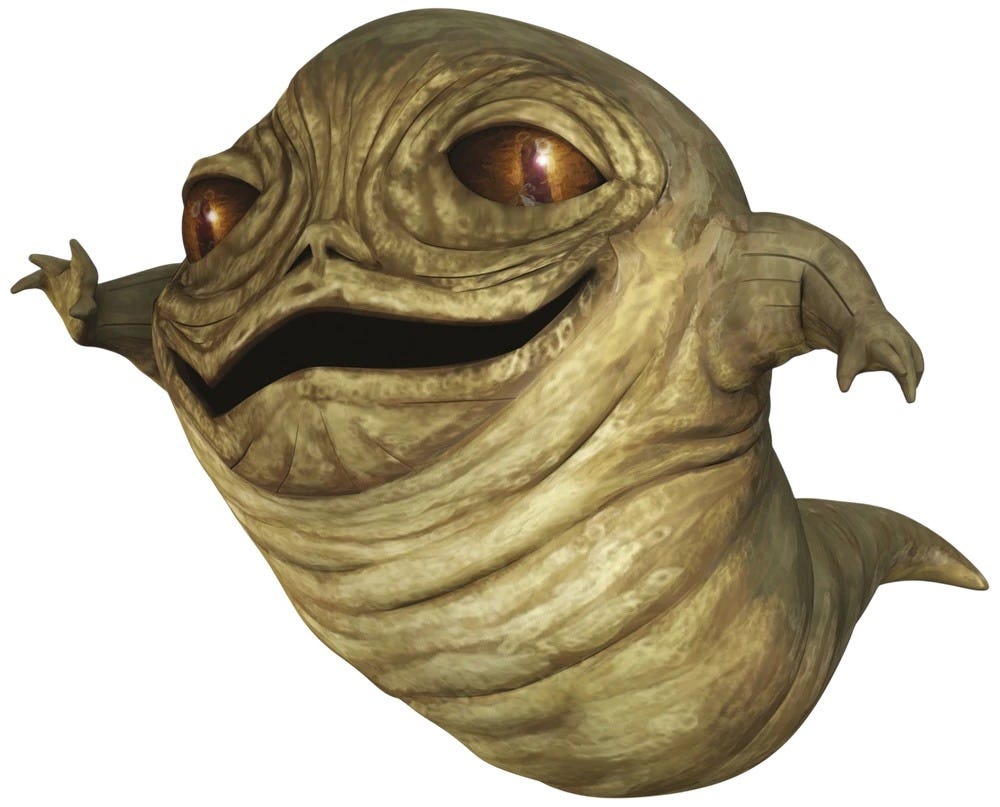
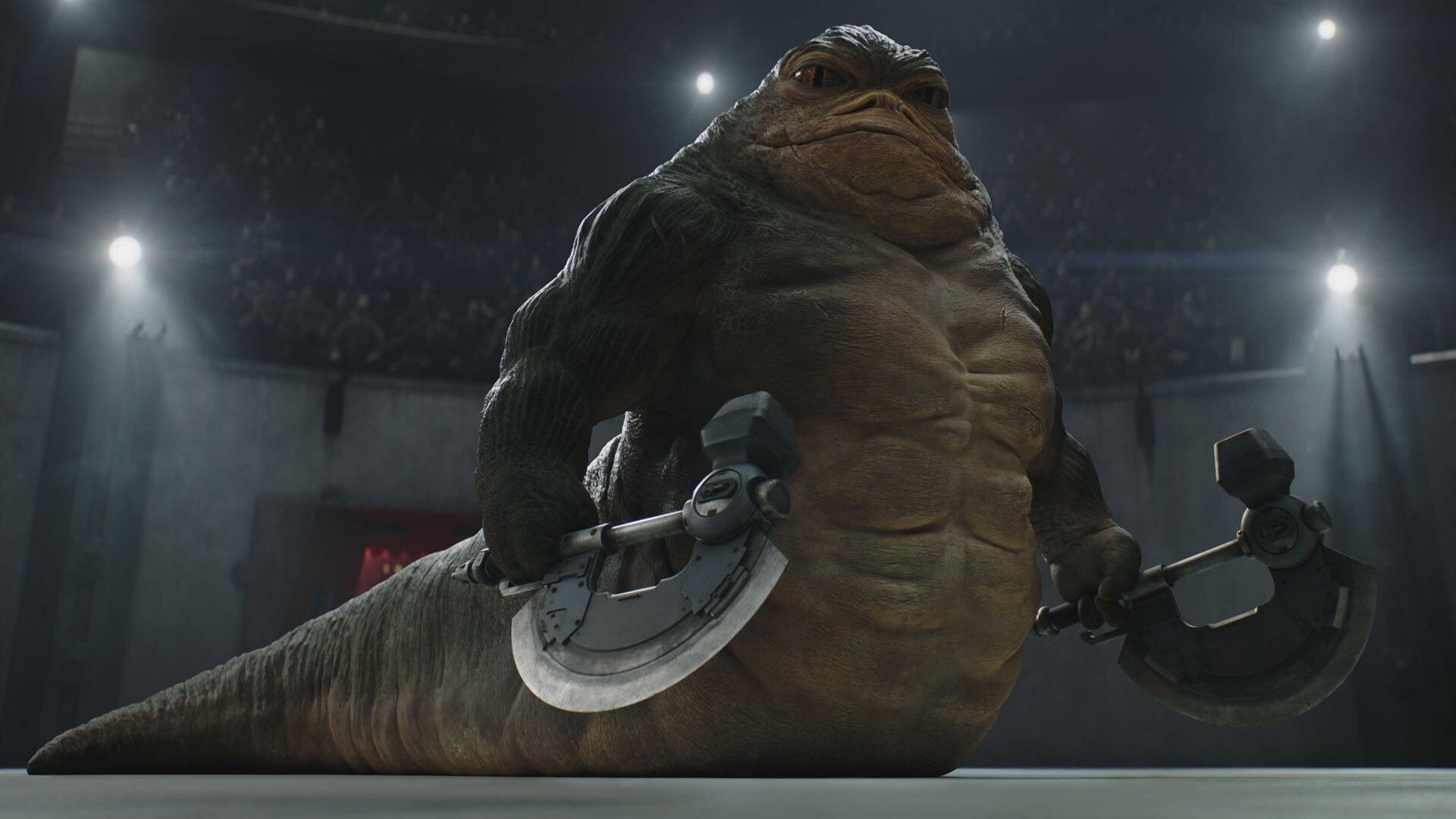
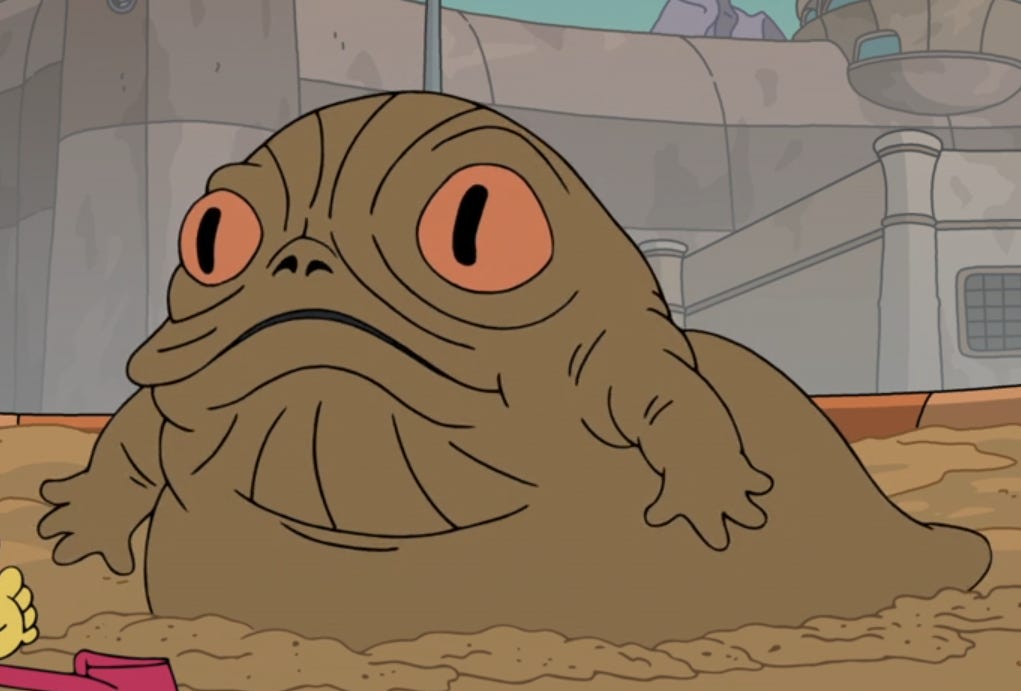
For those who did not watch Clone Wars, which set the precedent for offshoot material in the pre-Disney era of the franchise, Rotta is the son of Jabba the Hutt. As a young Huttlet, Jabba used to call him [Jabba voice] “pe-dun-kee muff-kin,” which translates to “punky muffin.” Jabba was one of the most iconic and disgusting alien creatures of the original trilogy, whose palace was the setting for Return of the Jedi’s first act, in which he made Princess Leia wear the obscene “slave” outfit which reconfigured the sexual maps of so many Gen-X men. I’m not sure if young Rotta was present when his father fell into the Sarlacc Pit, but he surely doesn’t show any grief over the old slab of blubber. Rotta, now fully grown, is imprisoned and fighting other aliens for the pleasure of spectators when Mando and his young force-sensitive companion are sent off to “free” him, intending to send him back to the Hutt palace where Jabba’s living relatives carry on his criminal ways. Played by Jeremy Allen White of The Bear, Rotta is an angry young man, an Emo Hutt, who we can assume carries the physique of a bodybuilder in order to spite his notoriously obese father. “Do you know how hard it is to be your own man when your father is Jabba The Hutt?” Rotta asks Pedro Pascal’s masked bounty hunter as Grogu, the prodigious animatronic creature casually known to the masses as “Baby Yoda,” empathizes with Rotta’s gesture of repudiation through his own facial expression. It’s all a bit ridiculous, right?
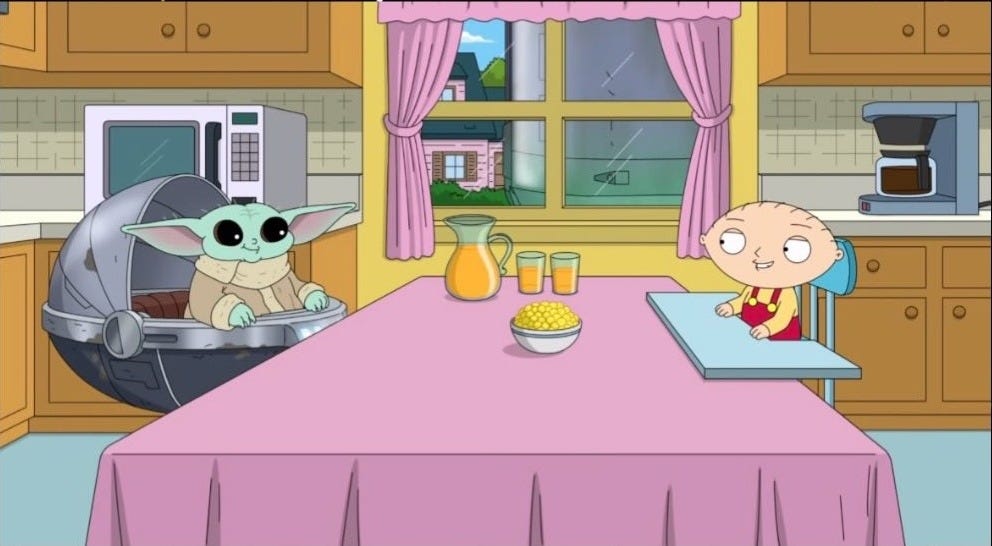
Well, back to the note of ‘drinking that garbage,’ I will continue to give Star Wars chances just like I continue to drink Diet Coke, despite knowing that it may be destroying my brain, and that the Coca-Cola corporation has probably done much more heinous shit than the supremely evil Disney corporation. I don’t even necessarily like classic Coca-Cola, because it is far too sweet, but I like to taste-test all of the dumb variants that they put out. I purchased a Diet Coke with Lime at 7-Eleven last year, and the first sip was one of the greatest sensations that I experienced in all of 2025. The rest of the bottle was disgusting, however, and the experience was quite similar to The Mandalorian and Grogu. I am not too old nor cynical to admit that I find Grogu incredibly cute. The mix of remote animatronics and puppeteering is a conscious respite to the CGI-laden universes and characters that comprise contemporary Hollywood cinema. I love the way he waddles, the way he eats, and in particular the way he jackhammers the shoulder of his father figure to get his attention in one scene. Did I mention how cute he is? He hangs out with a bunch of little alien mechanics called Anzellans, the race of creatures first showcased through Babu Frik, the only positive note in the otherwise dreadful Rise of Skywalker. When the film focuses on these diminutive and tactile creatures, we are undeniably in the Baby Mode that Star Wars so often veers toward, but for the first time in the series, I preferred these childish pleasures to the action and intergalactic politicking.
The biggest obstacle in Star Wars: The Mandalorian and Grogu is caring about The Mandalorian and his journey. Pedro Pascal’s “Din Djarin” doesn’t have much going for him besides playing the straight man to Grogu, but his steely affect can only be broken through with adorable “aw shucks” moments so many times. His antagonist in this adventure is the lazily-named Janu Coin, played by Jonny Coyne, who appears much closer to a John Wick villain than anything befitting this universe. The actual imagination of Star Wars, with its unique planets and creatures, leaves much to be desired in this entry. Looking for information, Mando meets Hugo Durant, played by Martin Scorsese. The multi-armed ape-like creature is of the same species (down to the New York accent) as Rio Durant, the pilot that director Jon Favreau played in Solo: A Star Wars Story. I do not particularly like the implications of this casting decision. Early on, Mando and Grogu visit a planet that is far too similar to Blade Runner for my taste, with its rain, neon, American urban architecture, and casting of human inhabitants. While I don’t require each and every locale to have a unique territorial gimmick, this is far from the pleasures of visiting Naboo or Mustafar. While director of photography David Klein (most renowned for his collaborations with Kevin Smith) isn’t going to wow anybody with his work, I find it commendable that this film is, at the very least, more legible than the gray murk of Rogue One and Solo: A Star Wars Story. What a low bar we have for cinematography.
Despite my reservations about the film’s creativity and, frankly, its need for existence, I have to admit that I found more pleasure in Star Wars: The Mandalorian and Grogu than much of what Disney has released under the Lucasfilm banner. It is a very minor film, fitting for the big-screen jump of a television show, but I find it to be less nauseating and more competent than the faux-maturity of Rogue One or the fan fiction of Solo: A Star Wars Story. All of that said, this is not a “good movie,” and Disney’s Star Wars still represents the death of Hollywood.