
The Odyssey
Welcome home, stranger

Vintage Violence is a blog about film, literature, and more. A majority of the posts are free, but you can subscribe at a paid tier to access the entire back catalog.
Just over a year ago, ahead of the release of Ryan Coogler’s Sinners, I wrote the following:
In the middle of the 20th century, film studios were doing anything they could to compete with the comfort of television. The obvious choice was to produce what the small, black-and-white screen couldn’t: grandeur….These efforts were in vain, and like so many historical empires of yore, Hollywood indulged in grandeur and decadence before its downfall.

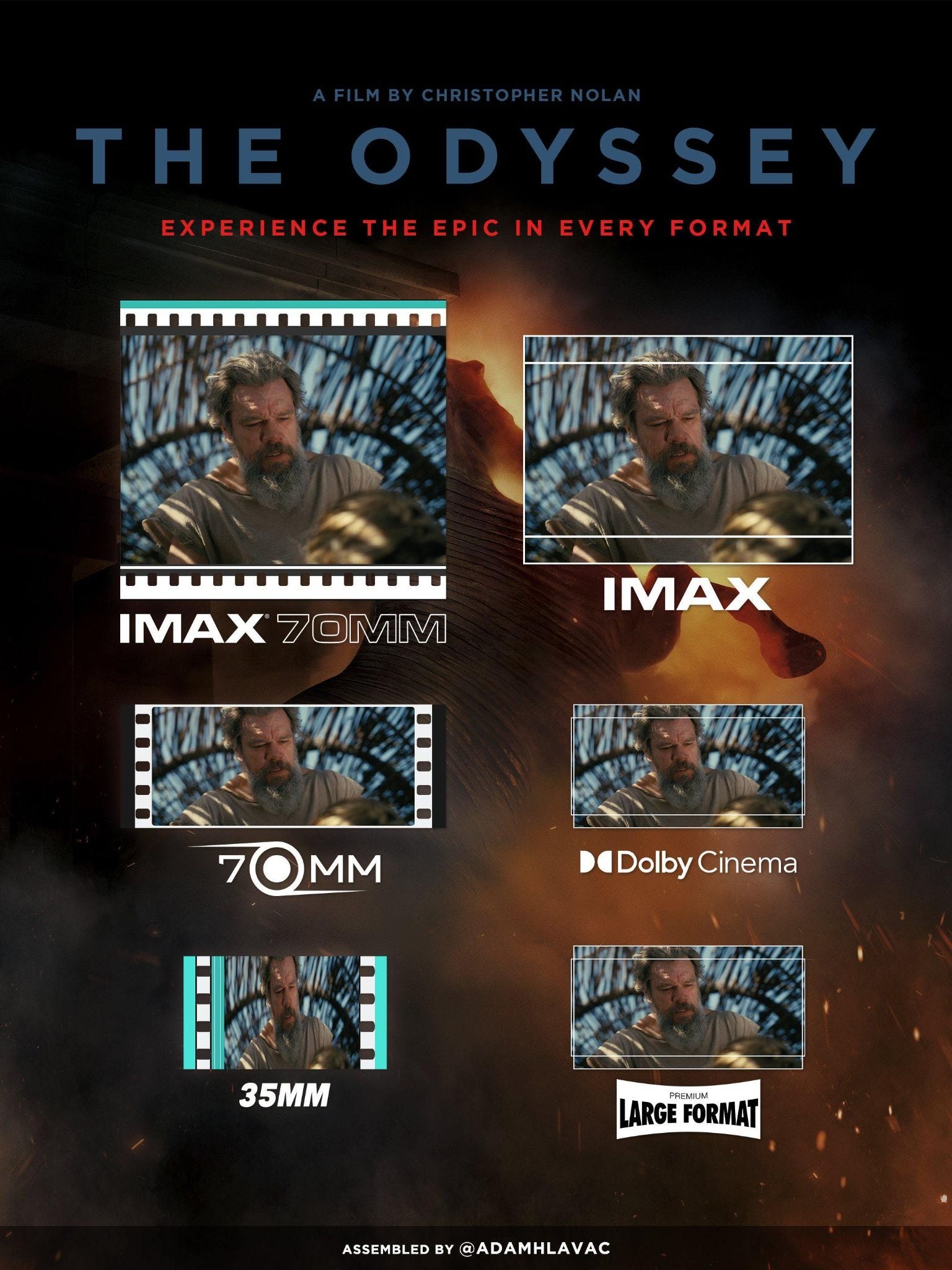
Well, we’re back again with yet another large-format epic, the gimmickry that Warners and now Universal have relied upon to placate cinephiles, to convince them that the Hollywood we knew and loved is still alive, and even bigger than ever. The purists may ask, “if you didn’t see The Odyssey in IMAX, did you really even see it?” Well, of course you did. Despite the fact that standard projection at so many multiplexes has become dim to the point of illegibility, this large-format fetishism seems to me nothing more than audience-sourced promotion for the studios who shelled out hundreds of millions of dollars for these films. “What about the intent of the auteur?” Sure, there is something to be said about the vision of a director and cinematographer being translated to exhibition, and yet, I can’t imagine that a filmmaker like Christopher Nolan (or Paul Thomas Anderson, or Ryan Coogler) would be so careless as not to protect framing for multiple aspect ratios. I think back to Stanley Kubrick, the control freak of control freaks, and the way his later films were exhibited in different shapes depending on the venue or region. In Europe, 1.66; Stateside, 1.85; on broadcast and VHS, 1.33. So, to get the nerd stuff out of the way up top, I saw The Odyssey in Dolby Vision, not just because of its ticket availability, but because that is the format I’ve come to enjoy at my multiplex chain of choice.
The success of Christopher Nolan’s films, to my taste, often depends on how well he balances dorky silliness with attempted self-seriousness. In The Odyssey, that pendulum regrettably swings a bit too far to the latter. The former is not without its memorable moments, however, including a genuinely shocking “welcome home, stranger” delivered upon Odysseus’ return, and a decent amount more Travis Scott than I expected.
In retelling Homer’s epic poem—whose story I won’t bother describing due to its bones being embedded into so many films and novels of the past—Nolan’s structure is that of flashbacks and stories within stories, which lends itself to the narrative’s episodic nature in addition to feeding into the meta idea of how stories themselves are told, a point that is hit on a bit too obviously in the film’s final moments. The near-inherent weakness of an episodic narrative is that, in most cases, some chapters will be weaker than others, provoking a “let’s get on to the next one” impulse in the viewer. While I found the cave of the cyclops and the pig transformations on Circe’s island (particularly the disgusting feasting that precedes it) to be the high points of the film, indulging in base genre pleasures about as well as its director ever has, I was disappointed by the rather unimaginative rendering of Hades, and the incessant cuts back to Calypso’s framing device. Resembling so many action films that struggle to break through to greatness, the setpieces are very fun, but all the humdrum in between about family, regret, and defying the gods is a good deal less engaging.
Taking one step beyond Nolan’s primary source material—the 2017 Emily Wilson translation—there is a fully modern feel to the language, with plenty of calls for “mom” and “dad,” even throwing in a couple uses of “shit,” and “fuck,” which will surely spark the ire of conservative viewers, the self-identifying historians that post online with statues as avatars, who were already upset about the multiethnic casting decisions. I found this approach to dialogue a somewhat bold populist choice, bringing into the fold as many viewers as possible to a film whose auteur clearly sees it as one of, if not the most important work of his career. Also, far too many historical films in this wheelhouse rely on bad British accents and faux-Shakespearean phrases to lend credence to their importance, which is thankfully disregarded here.
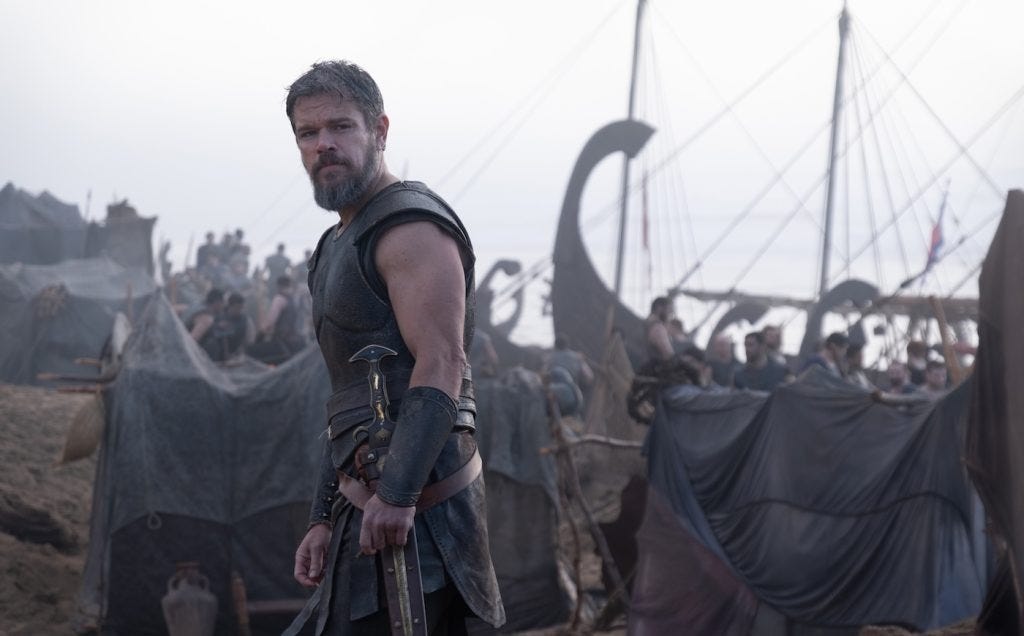
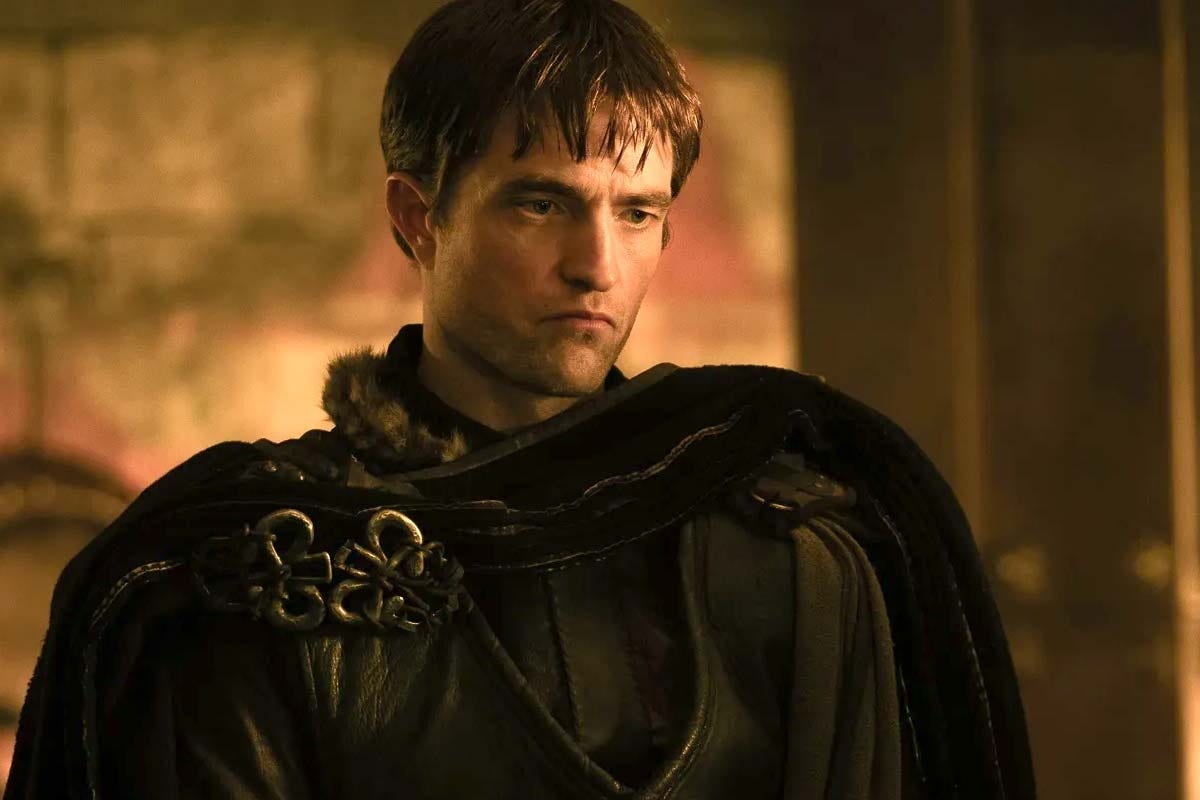
Like its 2004 predecessor Troy, which Nolan was once attached to direct, the style of performance can be described as either dynamic or inconsistent depending on how the viewer derives pleasure from acting. The cast is full of bankable stars, anything but unrecognizable as they flaunt their signature screen personas, filtered through Nolan’s coverage and Jennifer Lame’s editing. Jon Bernthal has never been more Jon Bernthal, but on the positive side of things, the overly-mannered style that Robert Pattinson has developed is channeled through James Woods in Casino. There is a dutiful solemnity to Matt Damon that brings the Homeric hero closer to the caped crusader responsible for Nolan’s infinite blank checks.
Much noise was made about this being the first ever film to be shot entirely on IMAX 70mm, and while unique formats are, at the very least, lightly interesting to most film fans, I couldn’t help but think of the camera’s limitations throughout the runtime. With only 50mm and 80mm lenses to choose from, there is not much dynamism to Nolan and Hoyte van Hoytema’s images, and some of the more intimate scenes really begged for a less arduous cinematographic process. In an early scene where Anne Hathaway’s Penelope attempts to lay down the law for Tom Holland’s Telemachus with a soft-focus background, the rack-focusing is downright sloppy, exposing the inability of the format to capture a good two-shot in which the characters are not in a straight line. While unconventional focus-pulling is not inherently bad, and plenty of great films indulge in it, I felt it took away from the otherwise magisterial quality. The choice to produce basically any medium to close shot in soft focus also obscures the lavish production design, nearly hiding the spectacle when the film is not being shot in a traditional IMAX wide. While this does largely play into my preference of the less busy frames that occupy the latter half of Christopher Nolan’s filmography, since he teamed up with van Hoytema, it is the least visually interesting film in their decade of collaboration.
Per usual with new releases, I like to look at it in the contemporary landscape as well as its place in film history. As far as major studio releases that I can see with my AMC A-List pass go, this is likely the best film of 2026 so far. That being said, we are in the midst of the most fallow period of studio filmmaking in history, so take it with a grain of salt. The Odyssey unabashedly revels in spectacle, which leaves me to wonder how it will play at home, where I have always watched and studied film history. Sure, something like The Searchers plays better on the big screen, having seen it on both 35mm and 70mm over the years, but those theatrical experiences never took anything away from the quality of the film when watched on Blu-ray or an .mkv file. The same cannot be said of Denis Villeneuve’s recent Dune films, as the Canadian filmmaker’s arc—from twisty crime thrillers to large-format tentpole blockbusters—is the closest contemporary parallel to the director of The Odyssey. While the two-part epic based on Frank Herbert’s novel was engrossing in its IMAX exhibition, I found the films largely boring when watched at home. I respect the work of Nolan a good deal more than Villeneuve, but one of my first thoughts upon reaching the parking lot was that this particular viewing will be the very best I will ever experience with The Odyssey. When films are regaled for their spectacle rather than a combination of narrative and form, they tend not to grow in my mind over time or upon subsequent viewings.
The Odyssey is as full of Nolanisms as anything he’s made in the last two decades—elliptical editing that borders on entire chunks of the film feeling like extended montage, an overbearing pulsating score that nonetheless attaches me into the editing rhythms of the film, a dumb moment for every smart one—but doesn’t quite live up to many of his other films. It’s not as clever as Memento or The Prestige, not as fun as Inception or the Batman films, and it holds the audience’s hand more than Tenet or Oppenheimer. It’s a fine, fun film, one that I was happy to drive across the San Fernando Valley to see, but I doubt that it will have the staying power that many of his films do beyond the theatrical experience.
This was around where I landed. Had a good time, might even see it again in theaters, but probably won’t think much of it aside from Travis Scott being awesome.